

 Account
 Language
 Time Zone
 COEF
COEF


What Is VAR in Football? The Video Assistant Referee Explained
Discover what is VAR in football, how it works, the four reviewable categories, and its impact on match statistics and outcomes. Explore more on Betiball.
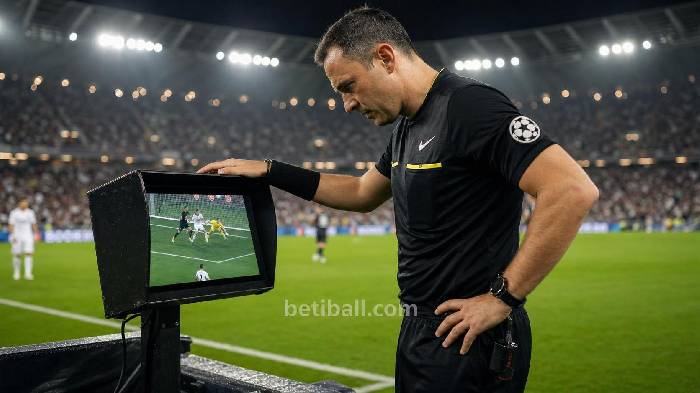


If you've watched any top-level football in the last several years, you've almost certainly seen a goal celebration cut short, a penalty awarded after a long delay, or a red card shown minutes after the original incident. The reason behind each of these moments is the same: VAR, or the Video Assistant Referee. Understanding what is VAR in football — how it operates, what it can and cannot review, and how it shapes match outcomes — is essential knowledge for anyone who takes football seriously, whether as a fan or as a bettor analysing match statistics. At Betiball, we believe that sharper knowledge of the rules leads to sharper analysis, so let's break this system down completely.
What Is VAR? Definition and Origins
VAR stands for Video Assistant Referee. In simple terms, it is a technology-assisted officiating system that allows a dedicated team of match officials — working from a remote video operation centre (VOC) — to review specific on-field decisions using multiple camera angles, slow-motion footage, and frame-by-frame analysis.
The VAR meaning in football goes beyond just "watching video replays." It represents a formal, rule-governed intervention protocol, governed by the International Football Association Board (IFAB) and FIFA. IFAB officially approved VAR for use in competitive football in March 2018, and it was deployed at its highest-profile stage — the FIFA World Cup — in Russia that same year.
Since then, VAR has been adopted in the Premier League (from the 2019–20 season), La Liga, Serie A, the Bundesliga, the UEFA Champions League, and dozens of other competitions worldwide. Its presence at the elite level is now universal, making it one of the most significant structural changes in football officiating in the sport's modern history.
Critically, VAR does not replace the referee. The on-field referee retains full authority to make the final call. VAR only advises, and only within strictly defined categories.
How VAR Works: The Four Reviewable Categories
One of the most common misconceptions about VAR is that it can review any decision. It cannot. IFAB's protocol restricts VAR intervention to exactly four categories of match-changing decisions:
- Goals and offences in the build-up to a goal — including offsides, fouls, and handball in the attacking phase
- Penalty decisions — whether a penalty should or should not have been awarded
- Direct red card incidents — serious foul play, violent conduct, or denying an obvious goal-scoring opportunity (DOGSO)
- Mistaken identity — when a yellow or red card is shown to the wrong player
Outside these four categories, VAR cannot intervene. A poor offside call on a non-goal phase, a missed yellow card, or a debatable throw-in decision — none of these fall within the system's remit.
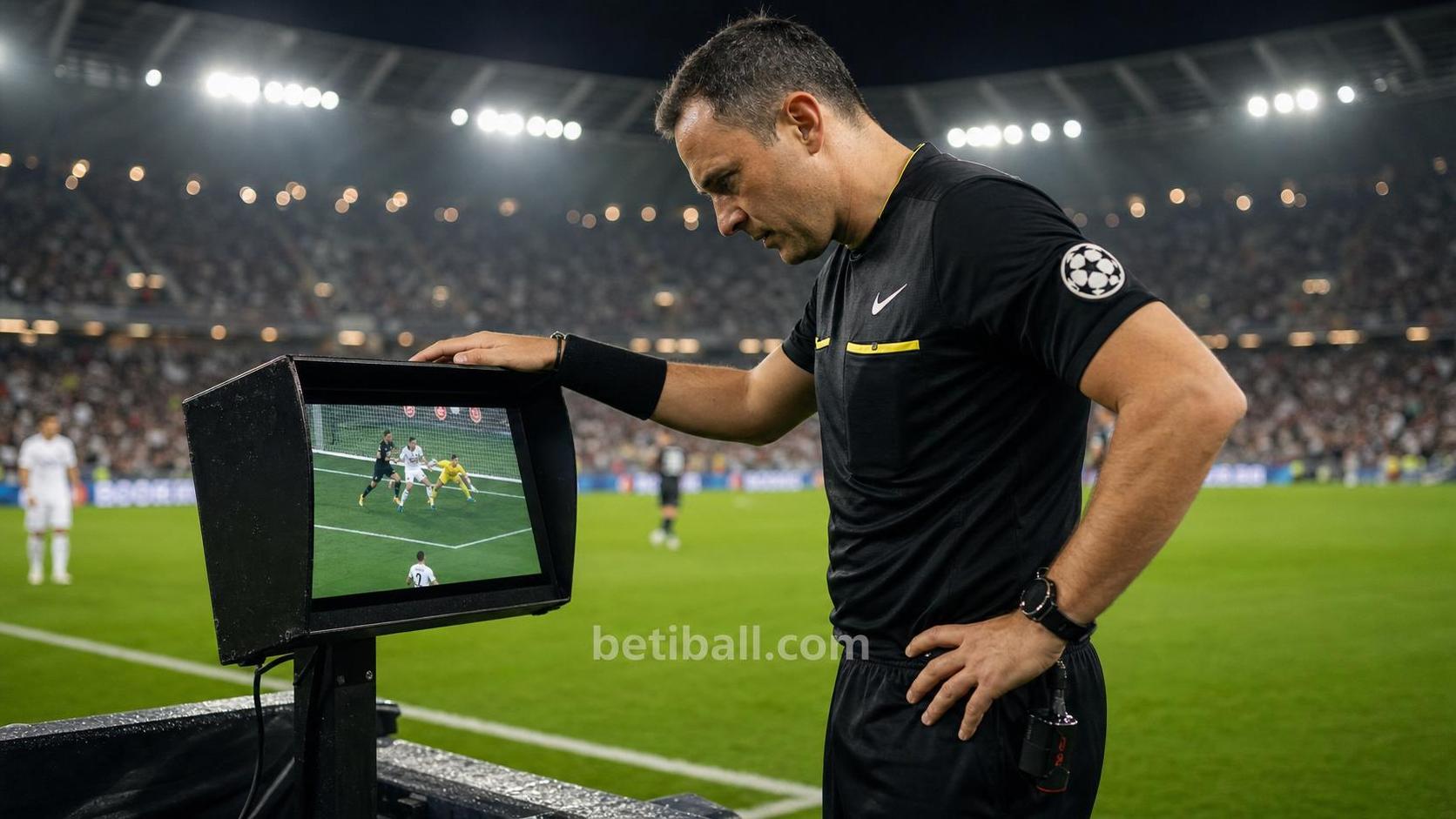
The review process follows a two-stage flow. First, the VAR team monitors all live footage passively and flags a potential "reviewable incident." Second, the VAR communicates with the on-field referee via headset. At this point, one of two outcomes happens: the referee accepts the VAR's recommendation and changes the decision (an automatic correction), or the referee chooses to conduct an On-Field Review (OFR) by walking to the pitchside monitor and watching footage personally before making the final call.
The threshold for intervention is important: VAR only acts on a "clear and obvious error". This phrase is central to how VAR rules are designed to work. Marginal calls, judgement-based decisions, and incidents that fall within the acceptable range of an on-field referee's discretion are deliberately left untouched.
A Numeric Example: VAR's Real Match Impact
To appreciate why understanding how VAR works matters for statistical analysis, consider the following real-world data points:
In the Premier League's first full season with VAR (2019–20), the system overturned or flagged reviews on approximately 190+ incidents across the 380-match season. Of those, penalty decisions were the single largest category reviewed. That season, the total number of penalties awarded increased notably compared to the pre-VAR average, with some analyses pointing to a rise of roughly 20–25% in penalty frequency in leagues that introduced VAR.
For a bettor or analyst, these numbers are significant. If VAR is active, the statistical base rates for:
- Penalties per match
- Goals per match (due to disallowed goals and added penalties)
- Red cards for serious foul play
...all shift compared to pre-VAR historical data. At Betiball, when we build match outcome models, we specifically segment pre-VAR and post-VAR seasons to avoid data contamination. Mixing historical pre-VAR league data with current VAR-era matches creates a statistical distortion that undermines prediction accuracy.
Additionally, VAR directly affects in-play match dynamics. A match paused for a VAR review typically introduces 2–4 minutes of stoppage time attribution. Teams that have conceded a VAR-awarded penalty show measurably different momentum patterns in the subsequent 10 minutes than teams that conceded a standard penalty. This is the kind of nuanced, data-backed context that shapes how we at Betiball present match statistics to our users.

When VAR Is Used: Competition-Specific Deployment
Not every football match in the world operates under VAR. Knowing where and when VAR is deployed is a critical piece of context for match analysis.
VAR is currently standard in:
- FIFA World Cup and AFC/UEFA/CONMEBOL continental championships
- UEFA Champions League, Europa League, and Conference League
- England's Premier League and Championship (VAR introduced at Championship level for 2024–25)
- Spain's La Liga, Italy's Serie A, Germany's Bundesliga, France's Ligue 1
- MLS (Major League Soccer)
VAR is not yet universally used in lower domestic divisions, most African league competitions, many Asian domestic leagues, and the majority of women's league competitions at non-elite levels (though international women's football at major tournaments does use it).
This means that when you're analysing a match from, say, the Polish Ekstraklasa or the Nigerian Professional Football League, VAR-era adjustments to penalty and red card base rates are not applicable. At Betiball, we tag each competition in our database by its VAR status precisely because of this contextual difference.
A further nuance: even within competitions that officially use VAR, technical failures, semi-automated offside system outages, and limited camera coverage in certain venues can temporarily disable VAR for specific matches. These incidents are rare but documented, and they represent outlier data points worth flagging in any serious statistical model.
Common Mistakes in Understanding VAR Rules
Even experienced football followers frequently misunderstand VAR rules explained at their technical level. Here are the most persistent errors we encounter:
1. "VAR checks everything." As we've established, VAR is restricted to four categories. It does not review tactical fouls, simulations that don't lead to a penalty, or any decision outside the four defined types. This misunderstanding often creates frustration when a clear yellow card offence goes unchallenged — VAR simply cannot intervene.
2. "If VAR didn't overturn it, the decision was correct." Not quite. VAR only overturns decisions that meet the "clear and obvious error" standard. A decision can be debatable and wrong, yet still fall within the range that VAR's protocol permits to stand.
3. "Offside VAR checks are always objective." Semi-automated offside technology (SAOT), introduced in major competitions from 2022 onwards, uses skeletal tracking and multiple camera inputs to draw offside lines. However, the positioning of the reference camera angle and the timing of the frame selected still involves a degree of methodological choice — meaning marginal offside calls remain contested even with the most advanced systems.
4. "VAR delays are wasted time." From an analytical standpoint, VAR pauses are not neutral. They alter crowd atmosphere, player concentration, and in-play dynamics in measurable ways. Studies tracking post-VAR-review goal rates suggest these interruptions create detectable short-term momentum shifts.
5. "Pre-VAR statistics and post-VAR statistics are interchangeable." As noted in our numeric example above, this is one of the most analytically costly mistakes you can make when building a prediction model or interpreting historical form data.

Conclusion: Why VAR Knowledge Sharpens Your Football Analysis
VAR is not a perfect system, and it was never designed to be. It is a structured, protocol-bound tool designed to correct only the most consequential and unambiguous referee errors. Understanding its precise scope — what it reviews, what it ignores, where it applies, and how it statistically shifts match outcomes — gives you a meaningful analytical edge over those who treat it as background noise.
At Betiball, every dataset we present and every match report we publish is built with this kind of contextual intelligence in mind. Whether you're tracking penalty frequency trends, evaluating a team's disciplinary record in VAR-reviewed competitions, or simply trying to understand why that goal was disallowed last weekend, knowing how VAR really works is foundational knowledge for any serious football analyst.
Explore our full range of match statistics, form data, and competition-level analysis tools to put this knowledge into practice.
Betiball does not accept bets. All examples are for educational purposes only.
Read more:
- Possession Percentage in Football: What It Means & Who Wins
- How Football Player Performance Rating Explained: What the Numbers Mean


Your feedback helps us deliver better football betting insights.