

 Account
 Language
 Time Zone
 COEF
COEF


Half Time Result Betting Tips: Predict the First Half
Learn how half time result betting works, with data-backed HT result prediction strategies and first half tips football bettors can apply. Explore more on Betiball.



If you've ever watched a football match and thought the first half told a completely different story from the final result, you already understand the core appeal of half time result betting tips. This bet type isolates the first 45 minutes as its own market, rewarding bettors who can read early game momentum, team structure, and tactical setup before the second half changes everything. Betiball tracks first-half statistics across hundreds of leagues, making it one of the most useful platforms for researching this niche but increasingly popular market.

What Is Half Time Result Betting?
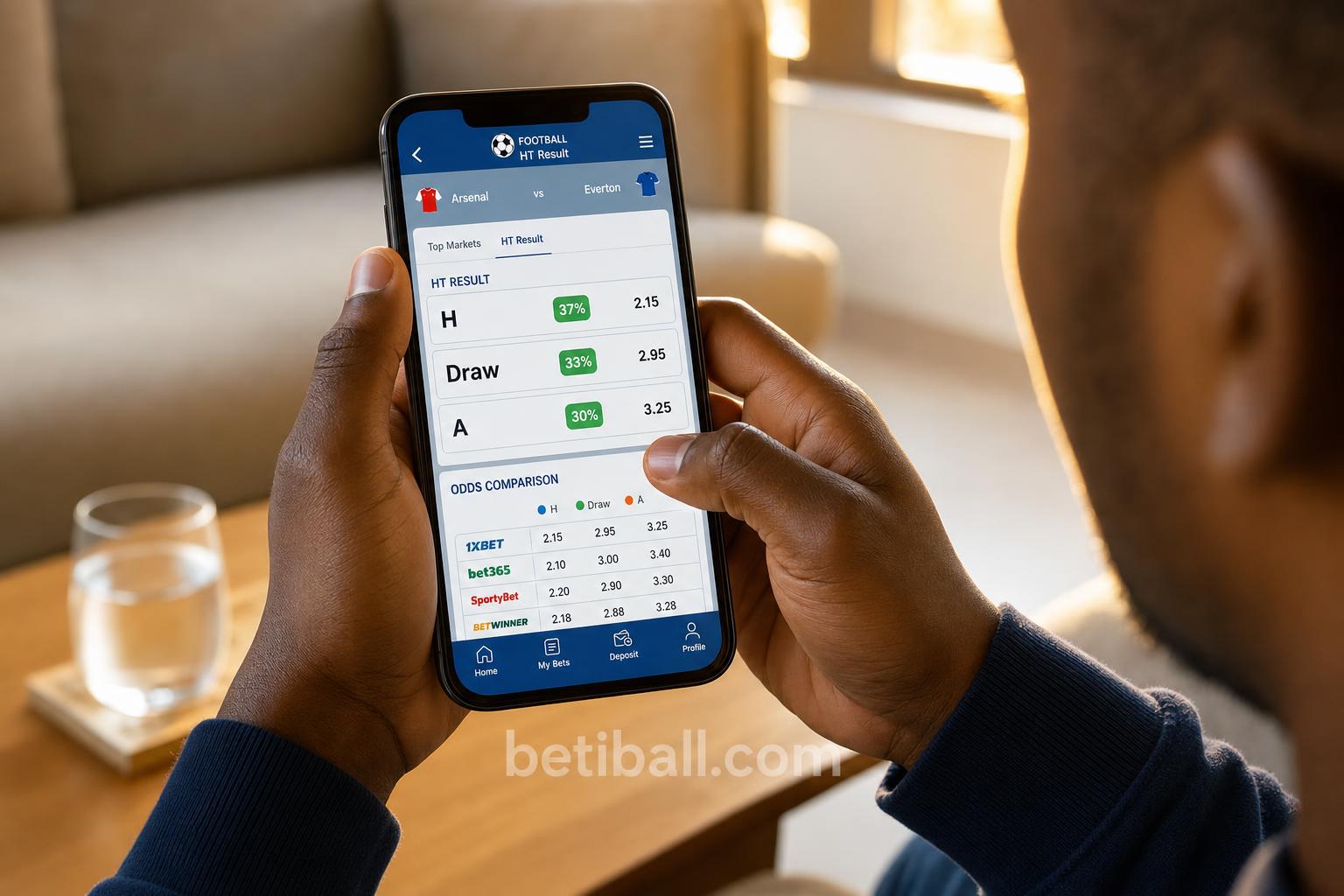
Half time result betting — sometimes called the HT result market or first half result — is a wager placed on which team will be leading (or if the scores will be level) at the end of the 45th minute, including any added injury time to the first half. The three possible outcomes mirror a standard 1X2 market:
- 1 — Home team leads at half time
- X — Scores are level at half time
- 2 — Away team leads at half time
Crucially, this market is entirely independent of the full-time result. A home team can lead 2–0 at the break and still lose 2–3 by full time. That independence is exactly what makes the HT result prediction market attractive: it demands a different analytical framework, one focused on first-half structure, pressing intensity, and early set-piece threat rather than overall match outcome.
Some sportsbooks extend this market into a half time score betting option, where you predict the exact scoreline at the break. These markets carry significantly higher odds and require a more granular statistical approach, which we'll touch on in the numeric example section below.

Understanding the mechanics helps you approach the market with structure rather than intuition alone. Here is how HT result prediction functions in practice:
Settlement: The bet is settled immediately after the referee blows the whistle for half time. Goals scored in the second half are irrelevant. Any goal from the first period — including injury time added to the first half — counts toward settlement.
Typical odds structure: In most balanced fixtures, the half-time draw (X) is the most statistically common outcome. Research across Europe's top five leagues consistently shows that between 35% and 45% of all matches are level at the break. This means the HT draw is often underpriced by casual bettors who assume the pre-match favourite will dominate from the whistle.
Correlation with team styles: Teams that deploy a cautious, low-block defensive structure in the first half to absorb pressure and hit on the counter tend to produce more half-time draws regardless of full-time outcome. Conversely, high-press sides — think teams replicating Klopp-era Liverpool or current Bayer Leverkusen pressing structures — tend to score earlier and lead more frequently at the break.
First half tips football analysts focus heavily on these structural tendencies rather than match-day motivation factors, which typically influence second-half performance more than first-half output.
Numeric Example: Breaking Down a Real Scenario
Let's build a worked example using realistic data to illustrate how a serious bettor would approach this market.
Fixture: Atletico Madrid (H) vs Sevilla (A), La Liga
Pre-match data points to consider:
- Atletico Madrid score in the first half in 38% of home matches this season
- Sevilla concede the first goal before the 45th minute in 29% of away fixtures
- The HT draw has occurred in 47% of all Atletico Madrid home matches across the last three seasons
- Atletico's average first-half xG at home: 0.61 — well below their second-half average of 1.12
- Sevilla's first-half goals conceded away: 0.7 per game
Implied probability from odds: If a bookmaker prices HT Home (1) at 2.20, that implies a 45.5% probability. But your data suggests the actual probability is closer to 35–38%. That is a negative value bet on the home team leading at half time.
Value outcome: The HT draw (X) is priced at 2.50 (40% implied probability), but historical data suggests a 47% actual frequency in similar Atletico home fixtures. This represents a potential edge of 7 percentage points — the kind of discrepancy that defines a value bet over a large sample.
This is the analytical process that separates professional half time score betting from guesswork. You are not predicting what will happen; you are identifying where the market has mispriced probability.
When to Use Half Time Result Betting
Not every fixture is suitable for HT result prediction. The following conditions typically present the strongest opportunities:
1. Matches involving defensively organized teams in the first half. Teams that historically sit deep and absorb pressure for the opening 45 minutes — many Italian Serie A sides, lower-half La Liga clubs, or newly promoted Premier League teams at home — produce HT draws at a significantly higher rate than the league average. Identifying these tendencies using team-level first-half statistics is a core skill.
2. Fixtures with high motivational asymmetry in the second half. When one team has a strong reason to attack only after half time — such as needing to overturn a first-leg deficit in a cup tie — the first half often plays out cautiously, increasing the probability of a level break.
3. Matches where the pre-match favourite has a poor record of first-half dominance. Many strong teams win matches through second-half quality, substitutions, or set pieces rather than early goals. Cross-referencing a team's first-half points percentage against their full-season points percentage can reveal significant discrepancies.
4. Early-season fixtures and post-international break matches. Tactical cohesion tends to be lower early in the season or after long breaks, which statistically leads to more cautious, balanced first halves and a higher frequency of HT draws.
Use Betiball's market filter pages to segment fixtures by first-half goal frequency, HT result history, and head-to-head HT data before committing to any selection in this market.
Common Mistakes in Half Time Result Betting
Even experienced bettors make avoidable errors in this market. Here are the most frequent pitfalls:
Mistake 1: Assuming the match favourite leads at half time. The pre-match favourite wins the full match more often than not — but that does not mean they lead at the break. Applying full-match probability logic to a 45-minute market is one of the most common and costly mistakes in HT result prediction.
Mistake 2: Ignoring first-half-specific statistics. Bettors who rely solely on overall league position, full-match xG, or season goals scored are missing the most relevant data layer. Always filter statistics to first-half periods only when researching this market.
Mistake 3: Overlooking the HT draw in favour of chasing higher odds on exact scores. Half time score betting on exact scorelines offers attractive odds but requires significantly more precision. Bettors without a deep statistical edge should treat exact HT scores as speculative rather than value-driven selections.
Mistake 4: Neglecting referee and match context. A referee with a high first-half card rate in competitive derbies can disrupt a team's pressing structure early, affecting first-half dynamics significantly. Match context — a must-win cup game, a dead-rubber league fixture — shapes tactical caution in the opening 45 minutes.
Mistake 5: Betting this market without a sufficient sample size of team data. Forming a HT result opinion on fewer than 10 first-half matches per team is statistically unreliable. The more data points available, the more robust the edge.

Conclusion: Build Your HT Betting Edge with Data
Half time result betting is not a shortcut to quick profits — it is a specialized market that rewards bettors who treat the first 45 minutes as a distinct tactical and statistical event. By focusing on first-half-specific data, understanding team structural tendencies, and identifying where bookmaker odds diverge from historical probability, you can develop a genuine and repeatable edge in this market.
The most important discipline is consistency: build a research process around first half tips football data, apply it to a filtered set of qualifying fixtures each week, and track your results to refine your model over time. The HT result prediction market is less heavily scrutinized by bookmakers than full-match markets, which means value opportunities appear with greater regularity for the prepared bettor.
Betiball does not accept bets. All examples are for educational purposes only.
Read more:

Your feedback helps us deliver better football betting insights.