


 Account
 Language
 Time Zone
 COEF
COEF


Arbitrage Betting in Football Explained: How It Works
Learn how arbitrage betting football explained works, with real examples and strategy tips for serious bettors. Explore more on Betiball.



If you've spent any serious time analysing football odds across multiple bookmakers, you've likely noticed that different platforms don't always agree on the same market. Those disagreements are not just interesting — they can be exploited. Arbitrage betting football explained simply: it is the practice of placing bets on all possible outcomes of a match across different bookmakers so that, regardless of the result, you lock in a guaranteed profit. It is not a theory. It is mathematics. And on Betiball, where we track thousands of odds data points across European and global football, we see the conditions for arb betting emerge more often than casual bettors realise.

What Is Arbitrage Betting in Football?
Arb betting football, sometimes called a sure bet in football circles, exploits the margin differences between competing bookmakers. Every bookmaker builds a vig (or overround) into their odds — the built-in profit margin that ensures they make money over time regardless of match outcome. But when two or more bookmakers price the same market differently enough, the combined overround across all outcomes drops below 100%. That gap is the arbitrage opportunity.
In a standard 1X2 football market, you have three outcomes: home win, draw, or away win. An arb exists when the implied probabilities of those outcomes — derived from the odds — sum to less than 100%. You back each outcome with a different bookmaker, stake-weighted precisely, and the profit is baked in from the moment you place your bets.
This is not gambling in the traditional sense. There is no prediction involved, no reliance on team form, expected goals, or tactical matchups. It is pure mathematical arbitrage — closer to financial spread trading than recreational betting.
How Does Football Arbitrage Actually Work?
The mechanics rely on one formula. Once you convert odds into implied probability (by dividing 1 by the decimal odds), you sum those probabilities across all outcomes. If the sum is less than 1 (or 100%), an arbitrage window exists.
The formula for identifying a sure bet football opportunity:
Arb % = (1/Odds_Home) + (1/Odds_Draw) + (1/Odds_Away)
If the result is below 1.00, you have an arb. The lower the number, the larger your guaranteed margin.
To calculate how much to stake on each outcome, you divide your total investment by the odds for each selection, then divide by the overall arb percentage. This distributes your bankroll proportionally so every outcome returns the same net profit.
Arbitrage opportunities in football tend to be small — typically between 1% and 4% margin — but they are risk-free when executed correctly and quickly. Speed matters enormously because bookmakers adjust odds continuously, and a window can close within minutes.
A Real Numeric Example of Football Arbitrage
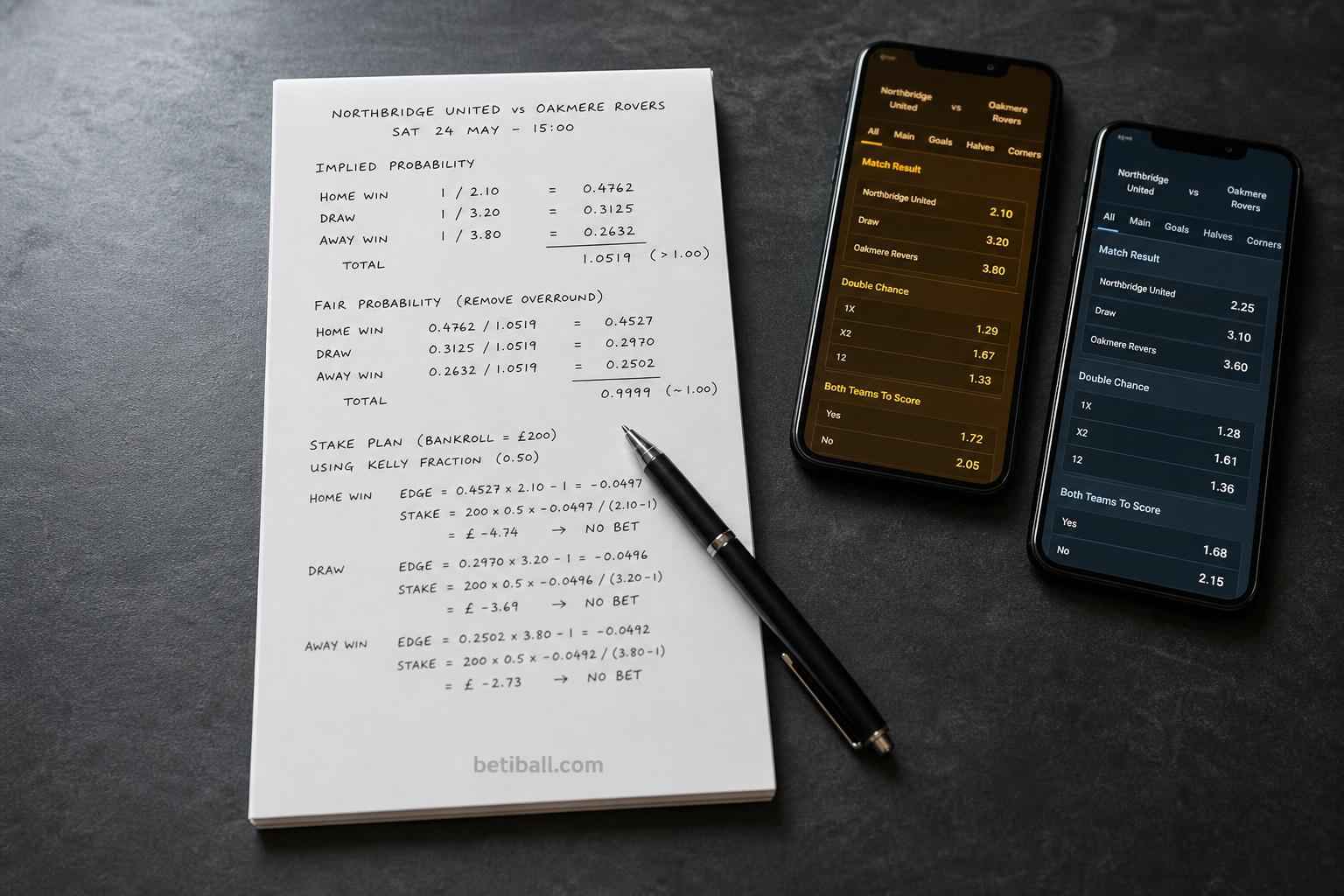
Let's run a concrete scenario using a fictional Premier League match between two unnamed sides. Suppose you find the following odds across three different bookmakers:
- Home Win: Bookmaker A offers 3.10
- Draw: Bookmaker B offers 3.40
- Away Win: Bookmaker C offers 4.20
Converting to implied probability:
- Home Win: 1 ÷ 3.10 = 32.26%
- Draw: 1 ÷ 3.40 = 29.41%
- Away Win: 1 ÷ 4.20 = 23.81%
Total: 85.48%
That total is well below 100%, confirming a significant arbitrage opportunity — in this case, approximately 14.5% margin. In reality, arbs this large are rare and usually signal a data error, but let's use it to demonstrate the stake calculation clearly.
With a total investment of £300:
- Stake on Home Win: (£300 ÷ 3.10) ÷ 0.8548 = £113.32
- Stake on Draw: (£300 ÷ 3.40) ÷ 0.8548 = £103.37
- Stake on Away Win: (£300 ÷ 4.20) ÷ 0.8548 = £83.61
Regardless of which outcome occurs, you return approximately £351 — a guaranteed profit of roughly £51 on a £300 outlay. A realistic arb of 2% on the same investment would return £6. Modest individually, but scalable across multiple opportunities per day.
When to Use Arb Betting in Football — and When to Avoid It
Arbitrage opportunities cluster around specific conditions. Understanding these helps you focus your scanning time effectively:
Best conditions for arb betting football:
- Early team news releases — odds shift when lineups drop; bookmakers don't all update simultaneously
- Lower-league fixtures — bookmakers invest less modelling resource in Championship, Ligue 2, or Segunda División markets, creating more pricing inefficiency
- Promotional boosts — enhanced odds offered by one bookmaker can flip a near-arb into a confirmed sure bet
- Live in-play markets — in-play odds fluctuate rapidly; automated arb scanners can identify windows measured in seconds
When arb betting becomes problematic:
- Account restrictions — bookmakers actively identify arbers through staking patterns and limit or close accounts. This is the single biggest practical barrier to long-term arb strategies
- Execution lag — if one leg of your arb is refused or the odds shift before you confirm the final bet, you may be left with an unhedged single position
- Withdrawal delays — your capital is often spread across multiple bookmaker accounts, reducing liquidity and increasing administrative overhead
Experienced arbers typically rotate across a portfolio of 10–20 accounts, bet in round numbers to avoid pattern detection, and never arb the same bookmaker in predictable sequences. It is, in effect, a second job.
Common Mistakes Bettors Make With Football Arbitrage
Even analytically minded bettors stumble when first approaching arb betting. These are the errors most likely to cost you:
1. Ignoring bookmaker terms and conditions. Many bonuses have restrictions that void winnings from obvious arb plays. Failing to read withdrawal conditions can lock profits inside accounts.
2. Miscalculating stakes under time pressure. Arb windows close fast. Bettors who rush calculations and place incorrect stakes risk turning a guaranteed profit into an unintended directional bet.
3. Overestimating available liquidity. Some bookmakers cap maximum stakes on certain markets. If you calculate a stake of £400 and the book only accepts £120, your arb math collapses.
4. Not accounting for withdrawal fees and currency conversion. For international markets, currency fees erode margins on small-percentage arbs quickly.
5. Treating arbing as passive income. The reality is active, time-intensive, and increasingly difficult as bookmakers deploy detection algorithms. Bettors who approach it passively typically find their accounts restricted within weeks.
The analytical bettor's edge in football rarely comes from one strategy alone. Arbing works best as one tool within a broader data-driven framework — used selectively, alongside value betting models and expected goals analysis, rather than as a standalone income stream.
Betiball does not accept bets. All examples are for educational purposes only.
Conclusion: Is Football Arbitrage Worth It?
Arbitrage betting in football is mathematically sound. The logic is watertight. The challenge is entirely operational — finding opportunities faster than the market corrects them, protecting accounts from detection, and maintaining the capital spread and discipline required to execute consistently. For the serious analytical bettor with time, multiple funded accounts, and a systematic scanning process, arb betting football strategies can generate steady low-risk returns. For the casual bettor, the overhead often outweighs the reward. The maths works. Whether the workflow works for you depends on how serious you are about treating football betting as a data discipline rather than entertainment.
Read more:

Your feedback helps us deliver better football betting insights.