

 Account
 Language
 Time Zone
 COEF
COEF


Draw No Bet Football Explained: How It Works và When to Use It
Learn what draw no bet football means, how it works, and when to use it strategically. Includes examples, DNB vs Asian handicap, and common mistakes. Explore more on Betiball.



If you have ever backed a team to win only to watch the match grind out a frustrating 1–1, you already understand the exact problem that draw no bet football is designed to solve. This market removes the draw from the equation entirely: your stake is refunded if the game ends level, and you win if your chosen side takes all three points. Simple in concept, yet consistently underused by bettors who could benefit from it most. On Betiball, you can filter fixtures by market availability, historical draw frequency, and team form — all the data points that make draw no bet a genuinely tactical weapon rather than a cautious fallback.

What Is Draw No Bet?
Draw no bet (DNB) is a two-outcome wager on a football match. You pick either the home or away team to win. If your selection wins, you collect your winnings at the quoted odds. If the match ends in a draw, your original stake is returned in full. The only scenario in which you lose money is if the opposite team wins.
Structurally, draw no bet sits between a standard match winner (1X2) bet and a more complex handicap market. In a 1X2 market you have three outcomes — home win, draw, away win — and a draw loses your stake entirely. DNB collapses that to a binary choice by neutralising the draw result. Bookmakers compensate for this reduced risk by offering lower odds than the equivalent 1X2 selection. That trade-off is deliberate, and understanding it is the foundation of any coherent DNB strategy.
It is also worth noting how the market appears in different formats. In Asian betting markets, draw no bet is mathematically equivalent to an Asian Handicap 0 (AH0). Both return your stake on a draw. The terminology differs, but the arithmetic is identical — a distinction we will return to when comparing draw no bet vs Asian handicap later in this guide.

How Draw No Bet Works: A Step-by-Step Breakdown
The mechanics are straightforward once you walk through them systematically. Here is the full lifecycle of a draw no bet wager:
- Selection: You choose the team you believe will win — home or away.
- Stake placement: You place your chosen amount at the DNB odds offered by the sportsbook.
- Match plays out: Three outcomes are possible — your team wins, the opposing team wins, or the match draws.
- Settlement: Win → you receive stake plus profit. Draw → stake returned, no profit, no loss. Loss → stake forfeited.
One important practical note: draw no bet settlement applies to the result at 90 minutes plus injury time. Extra time and penalty shootouts in cup competitions do not count unless explicitly stated by the operator.
Numeric Example
Suppose Atletico Madrid are playing Valencia in La Liga. The 1X2 odds are:
- Atletico Madrid win: 1.80
- Draw: 3.40
- Valencia win: 4.50
The draw no bet market for Atletico Madrid is quoted at 1.45. You stake €100.
- Atletico Madrid win: Return = €100 × 1.45 = €145. Profit = €45.
- Draw: Return = €100. Profit = €0. Stake refunded.
- Valencia win: Return = €0. Loss = €100.
Compare this to the 1X2 bet on Atletico at 1.80: a draw would cost you the full €100 stake. The DNB market reduces your potential return (€45 profit vs €80 profit) but eliminates the draw risk entirely. Whether that trade-off is worth it depends on how likely a draw actually is — which is precisely where statistical analysis earns its keep.
Draw No Bet vs Asian Handicap: Key Differences
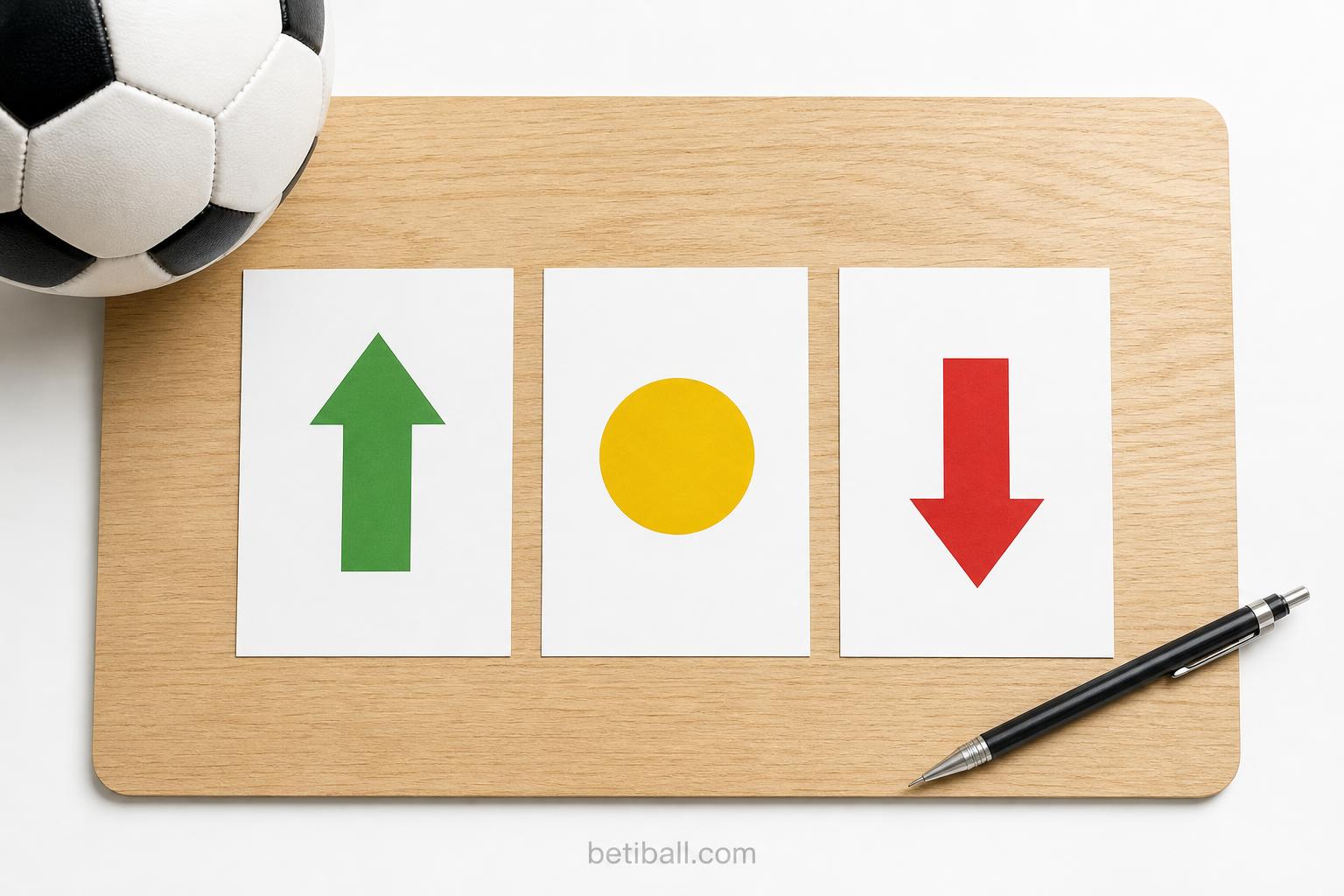
The comparison between draw no bet vs Asian handicap is one of the most common points of confusion in football betting, and it deserves a precise answer.
As mentioned, draw no bet is mathematically equivalent to an Asian Handicap of 0. Both markets behave identically on a full-time draw result — your stake is returned. However, the two markets diverge significantly the moment handicap lines move away from zero.
An Asian Handicap of -0.5 means your selection must win by at least one goal. A draw returns nothing; you lose your stake. An AH of +0.5 means your team can lose by one goal and you still win the bet, while a draw is also a winning outcome. These lines offer greater flexibility in expressing a view on the margin of victory, but they do not offer the same draw protection as a true DNB market.
The practical distinction for bettors: use draw no bet when you want clean, binary protection against the draw without taking on goal-margin risk. Use Asian handicap lines when you have a specific view on the scoreline range and want to access better odds by accepting additional conditions.
From an odds-efficiency perspective, Asian handicap markets typically carry lower overrounds than DNB markets at many sportsbooks, making them slightly better value for bettors with precise models. For casual-to-intermediate bettors, DNB is simpler to evaluate and easier to manage within a structured staking plan.
When to Use Draw No Bet: Strategy and Selection Criteria
DNB betting is most valuable in specific statistical contexts. Here are the scenarios where the market genuinely earns its reduced odds:
1. High Draw-Probability Fixtures
Leagues with historically elevated draw rates — Serie A, La Liga, and Ligue 1 have all averaged above 26% draw frequency in recent five-year periods — create environments where DNB protection has direct expected value. When two evenly matched teams meet, a draw is no longer a tail risk; it is a mode outcome. In those fixtures, backing a slight favourite on DNB rather than 1X2 is a mathematically defensible position.
2. Short-Priced Favourites in Risk-Averse Contexts
When you identify a strong favourite priced at 1.30–1.50 in the 1X2 market, the DNB odds will typically fall between 1.15 and 1.25. That looks unattractive in isolation, but paired with a unit staking strategy and a high-confidence model output, DNB allows you to protect against the one result (a draw) that turns value plays into losses. Over a large sample, eliminating draw losses on short-priced favourites measurably improves return on investment for disciplined bettors.
3. Cup Ties and One-Off Knockout Matches
In knockout football, teams that would ordinarily attack freely sometimes prioritise not losing over winning. Defensive setups, parking the bus, counter-attack systems — all of these increase draw probability. DNB is a logical hedge when the tactical setup of a match makes 0–0 or 1–1 a realistic equilibrium outcome.
4. Combining With Accumulators (With Caution)
Including DNB selections in an accumulator reduces overall payout odds significantly, but it also means a single drawn match does not bust the entire bet — the draw leg is simply removed and the accumulator continues with the remaining selections. This is an accepted approach in bankroll management for risk-averse accumulator builders, though it requires careful odds calculation to confirm the bet retains positive expected value.
Common Mistakes Bettors Make With Draw No Bet
Despite its straightforward structure, DNB betting produces several recurring errors that erode long-term profitability.
Mistake 1: Using DNB as a default safety net regardless of odds value. Draw no bet does not transform a losing pick into a winning strategy. If the underlying 1X2 selection is poor value, DNB simply reduces losses more slowly. Always assess the implied win probability first.
Mistake 2: Ignoring the draw frequency of the specific match. Applying DNB to a game between two high-scoring, attacking teams with a combined 0.8% draw rate in recent form is using a protection instrument where no protection is statistically warranted. Reserve DNB for fixtures where the draw probability meaningfully exceeds the bookmaker's implied draw odds.
Mistake 3: Confusing DNB with double chance. Double chance (1X or X2) allows you to cover both the win and the draw as winning outcomes — a fundamentally different bet. DNB only refunds on a draw; it does not pay out on one. Conflating the two leads to incorrect staking and misaligned expectations.
Mistake 4: Overlooking the overround on DNB markets. Some sportsbooks apply a higher margin to DNB than to 1X2 or Asian handicap equivalents. Always cross-check the implied probability of the DNB odds against the market's full overround before placing.
Mistake 5: Not recording draw refund outcomes separately. Bettors tracking performance often log a stake refund as a neutral event and exclude it from ROI calculations. Over time, this distorts your true performance metrics. Track refunded stakes as zero-profit outcomes to maintain accurate expected value modelling.
Betiball does not accept bets. All examples are for educational purposes only.
Conclusion
Draw no bet is a market built for bettors who have already done the analytical work and simply want to remove one specific variance point — the draw — without taking on the complexity of Asian handicap lines. Used correctly, in high draw-probability fixtures, on well-researched selections, and within a disciplined staking framework, DNB is a legitimate and effective tool. Used lazily as a blanket hedge, it quietly erodes the value in every bet you place. The difference between those two outcomes is entirely in how rigorously you apply the underlying data — and that is exactly what platforms like Betiball are built to support.
Read more:

Your feedback helps us deliver better football betting insights.