


 Account
 Language
 Time Zone
 COEF
COEF


Cards Betting Guide: Yellow Cards, Bookings Markets và Statistical Patterns
Master the football cards betting guide: yellow cards, bookings markets, cards per game stats and referee patterns. Build a real edge. Explore more on Betiball.



The football cards betting guide most bettors overlook is the one that could quietly sharpen their edge. While goals dominate the headlines, the bookings market offers a quieter, data-rich environment where disciplined analysis consistently outperforms gut instinct. Whether you are backing total cards in a match, betting on a specific player to receive a yellow, or targeting the first booking of the game, understanding the statistical patterns behind referee behavior and team tendencies is non-negotiable. Betiball aggregates the exact cards-per-game data and referee statistics you need to make these decisions with precision.

Who This Guide Is For
This guide is written for bettors who already understand basic football wagering and want to explore specialist markets beyond 1X2 and over/under goals. Specifically, you will benefit from this content if:
- You have placed bets before but feel the cards market is unpredictable without a clear framework
- You want to use statistics rather than opinion to inform your selections
- You are interested in markets with potentially softer lines, where bookmakers price loosely compared to main markets
- You follow specific leagues or competitions closely and have access to granular team and referee data
This is not a beginner's introduction to sports betting. The tone here is analytical. We focus on practical methodology backed by observable statistical patterns rather than general tips or hype.
Understanding the Basics of Cards Betting Markets
Before building a strategy, you need a clear picture of what you are actually betting on. The bookings market comes in several formats, and confusing them is one of the most common and costly mistakes new participants make.
Common Cards Betting Market Types
- Total cards in a match: A straightforward over/under line, typically set between 3.5 and 5.5 cards. You back more or fewer bookings than the bookmaker's threshold.
- Asian handicap cards: Works identically to goal handicaps. One team starts with a virtual card deficit, evening out the implied probability between sides.
- First card of the match: Which team receives the first yellow or red card. Useful when one team plays aggressively in the opening phase of games.
- Player to be booked: Backing a named player to receive at least one yellow card. Often available in pre-match and live markets.
- Bookings points market: Yellow card = 10 points, red card = 25 points. You bet over or under a total points threshold. This is common with UK-facing bookmakers.
- Both teams to receive a card: A binary yes/no market on whether each side picks up at least one booking.
Understanding which market you are entering matters because each one carries different variance and requires slightly different analytical inputs. The total cards market and bookings points format are the most statistically tractable, making them the primary focus of this guide.
Key Statistics That Drive Yellow Cards Betting
The bookings market, more than almost any other bet type in football, rewards those who understand the specific variables at play. Goals involve randomness and finishing quality that is hard to predict game-to-game. Cards, by contrast, correlate more reliably with measurable factors: referee tendencies, team playing style, match stakes, and tactical setup.
1. Referee Cards-Per-Game Average
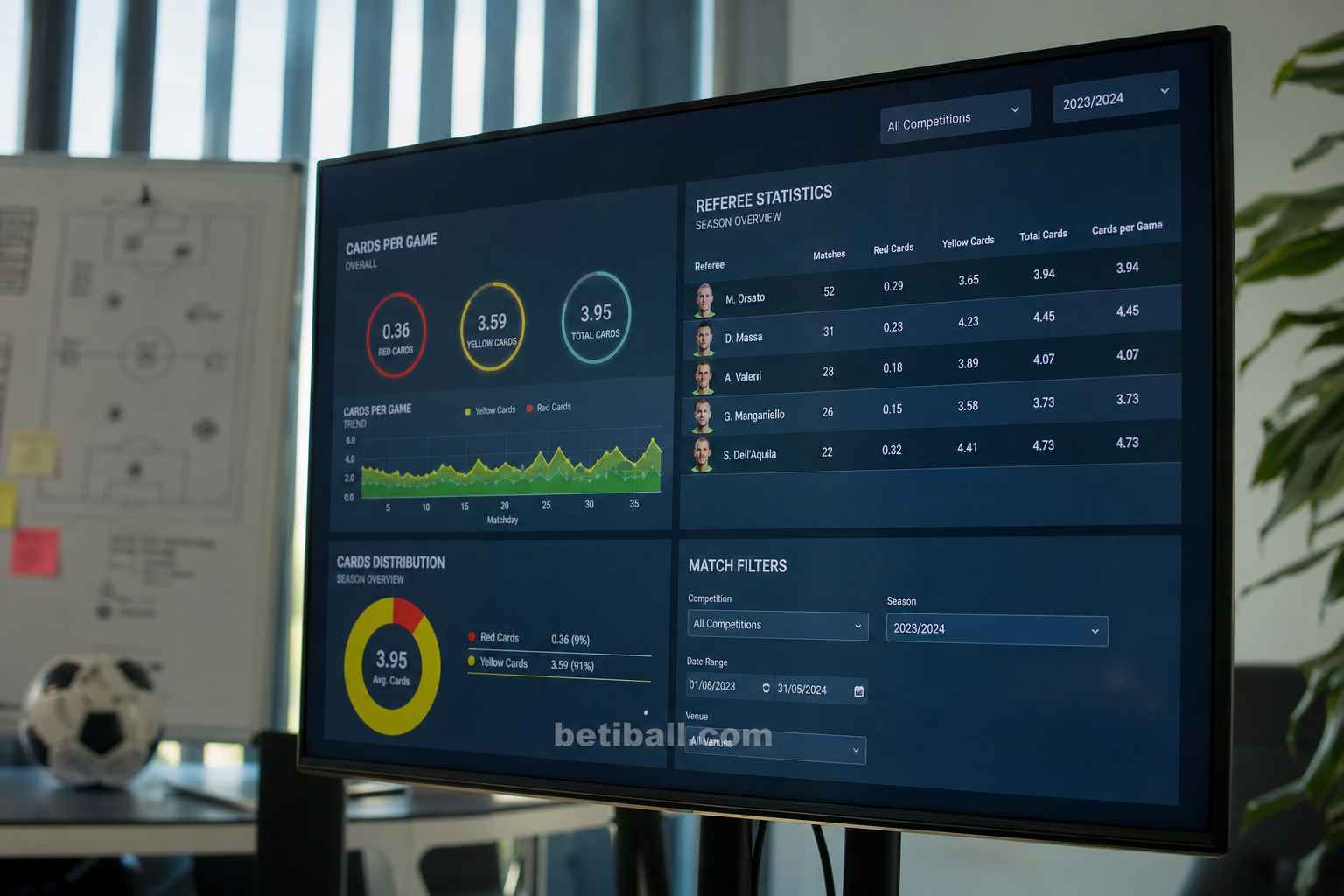
This is the single most important variable in any cards analysis. Referees vary dramatically in their booking frequency. In the English Premier League, the average across all officials sits roughly between 3.8 and 4.5 cards per game across a season, but individual referees can deviate significantly from that mean. Some officials consistently average under 3.0 bookings per match. Others rarely finish a game without five or more.
Before building any cards model for a specific fixture, identify the assigned referee and pull their cards-per-game statistics for the current season. Historic seasonal averages are useful but the current season sample is more actionable. Referee behavior evolves, and career averages can mask meaningful recent trends.
2. Team Cards-Per-Game Statistics
Teams accumulate cards at measurable rates. Sides with high-press systems, aggressive midfields, or defensive structures built around tactical fouling will generate more bookings. Look at:
- Cards received per game (home and away split separately)
- Cards committed per game in different match contexts (winning, drawing, losing)
- Opponent impact — some teams consistently draw high-card matches due to their style of play
Home/away splits are particularly important. Teams often play more conservatively away, absorbing pressure and fouling more frequently. The away side in a competitive fixture typically accumulates more yellow cards than the home side across large sample sizes.
3. Match Context and Stakes
Derby matches, relegation six-pointers, and cup ties with elimination implications all produce elevated card counts compared to mid-table fixtures with little riding on them. Competition stage matters. Early group-stage games in European competitions often produce fewer bookings than knockout legs. Domestic league matches with title or survival implications push card averages up measurably.
4. League-Level Baselines
Different leagues operate under different disciplinary cultures. La Liga historically produces more cards per game than the Bundesliga. The Championship in England is consistently one of the highest-carding second divisions in European football. Establishing your baseline for each league you bet into prevents the error of applying one market's expectations to another.

Advanced Strategy for the Bookings Market
Once you are comfortable with the statistical inputs, the next layer is knowing how to combine them into a consistent decision-making process.
Build a Simple Expectation Model
For total cards markets, a straightforward approach is to combine referee average + home team average cards + away team average cards, then apply a weighting for match context. This produces an expected cards figure for the fixture. Compare it against the bookmaker's line. If your model suggests 4.8 cards and the line is 3.5, you have an identified edge on the over. If the line is 5.5 and your figure is 4.2, consider the under.
This is not a guarantee of profit — variance exists in any single game. The goal is to make positive expected value decisions over time, not to win every bet.
Player Booking Markets: Targeting High-Risk Positions
Central midfielders and defensive fullbacks accumulate bookings at the highest rates in most team structures. When backing a player to be carded, prioritize:
- Players with high bookings rates in the current season (not just career averages)
- Players who have already been booked once and face yellow card accumulation pressure (though some referees ease off on near-suspended players)
- Pressing midfielders operating against technically superior opponents in away fixtures
Line Shopping in the Bookings Market
Bookmakers price cards markets less carefully than main markets. This creates genuine opportunity for line shopping. A total cards line offered at 4.5 by one bookmaker may be 3.5 at another for the same game. Given the statistical nature of your analysis, finding the best available number for your identified position is as important as the selection itself.
Cards Betting Strategy Checklist
| Factor | What to Check | Priority |
|---|---|---|
| Referee assignment | Cards per game average (current season) | Critical |
| Home team cards rate | Yellow cards received per game at home | High |
| Away team cards rate | Yellow cards received per game away | High |
| Match stakes | Derby, relegation, title implications | High |
| League baseline | Average cards per game in this competition | Medium |
| Tactical matchup | Press-heavy vs. possession-based systems | Medium |
| Player selection (if applicable) | Individual bookings rate, position, opposition quality | Situational |
| Line comparison | Best available number across bookmakers | Always |

Common Mistakes to Avoid in Yellow Cards Betting
Even analytical bettors fall into predictable traps in this market. The most common errors include:
- Ignoring the referee: Treating all fixtures as interchangeable without adjusting for the official's tendencies is the most costly oversight.
- Using career averages instead of current season data: A referee who averaged 4.5 cards per game over their career may be officiating at 3.2 this season. Use the most recent data.
- Overweighting single high-card games: One nine-card thriller does not redefine a team's booking profile. Look at at least ten to fifteen games for a meaningful sample.
- Conflating aggressive style with high card counts: Some physically aggressive teams play in leagues or face referees who do not card frequently. Style alone is not the variable — style in context is.
- Ignoring live market adjustments: If a red card is issued early in a match you are watching live, the total cards over/under changes dramatically. Match state after major events creates fresh opportunities.
Betiball does not accept bets. All examples are for educational purposes only.
Conclusion
The bookings market rewards patience, data discipline, and a willingness to focus on factors that most recreational bettors ignore entirely. By building your analysis around referee tendencies, team cards-per-game statistics, and match context, you create a repeatable framework rather than a series of random guesses. Use the checklist above before every cards bet you place, pull accurate cards-per-game statistics from a reliable source, and track your results by market type to understand where your edge genuinely lies.
Explore referee statistics, team booking rates, and fixture filters to support your cards market analysis. Explore more on Betiball.
Read more:

Your feedback helps us deliver better football betting insights.