


 Account
 Language
 Time Zone
 COEF
COEF


Recency Bias in Football Betting: Stop Losing to Your Own Brain
Recency bias in football betting leads to costly overreactions. Learn how to use form vs long-term stats for smarter, data-driven decisions. Explore more on Betiball.



Most football bettors don't lose because they lack information — they lose because they trust the wrong information too much, too fast. Recency bias in football betting is arguably the single most destructive cognitive pattern affecting recreational and semi-professional bettors alike. It is the mental shortcut that makes last weekend's 4-0 demolition feel more meaningful than six months of underlying data — and it is costing you money in ways you probably haven't fully accounted for. If you're serious about improving your edge, Betiball is built precisely for this kind of analytical work.

What Recency Bias Actually Does to Your Betting Decisions
Recency bias is a well-documented cognitive bias in behavioural economics. It describes the human tendency to assign disproportionate weight to recent events when forming judgments about future outcomes. In football betting, this manifests in a precise and predictable way: a team wins three matches in a row and bettors flood their money onto them, regardless of the quality of opposition, the underlying expected goals (xG) data, or the injury list. Conversely, a traditionally strong side loses two consecutive games — maybe against top-six opposition, maybe with three first-team starters absent — and the market treats them as though they've forgotten how to play football.
The result is systematic mispricing driven not by logic but by narrative. And wherever mispricing exists, the bettor who resists the narrative has an opportunity. The problem is that resisting recency bias requires you to consciously override what feels intuitively correct, which is genuinely hard.
Research published in the Journal of Behavioral Decision Making found that amateur sports bettors consistently overweighted the last three to five match outcomes when estimating future win probability, even when provided with longer-term statistical baselines. That gap between perceived probability and actual probability is the recency trap.
The Data Case Against Overreacting to Recent Results
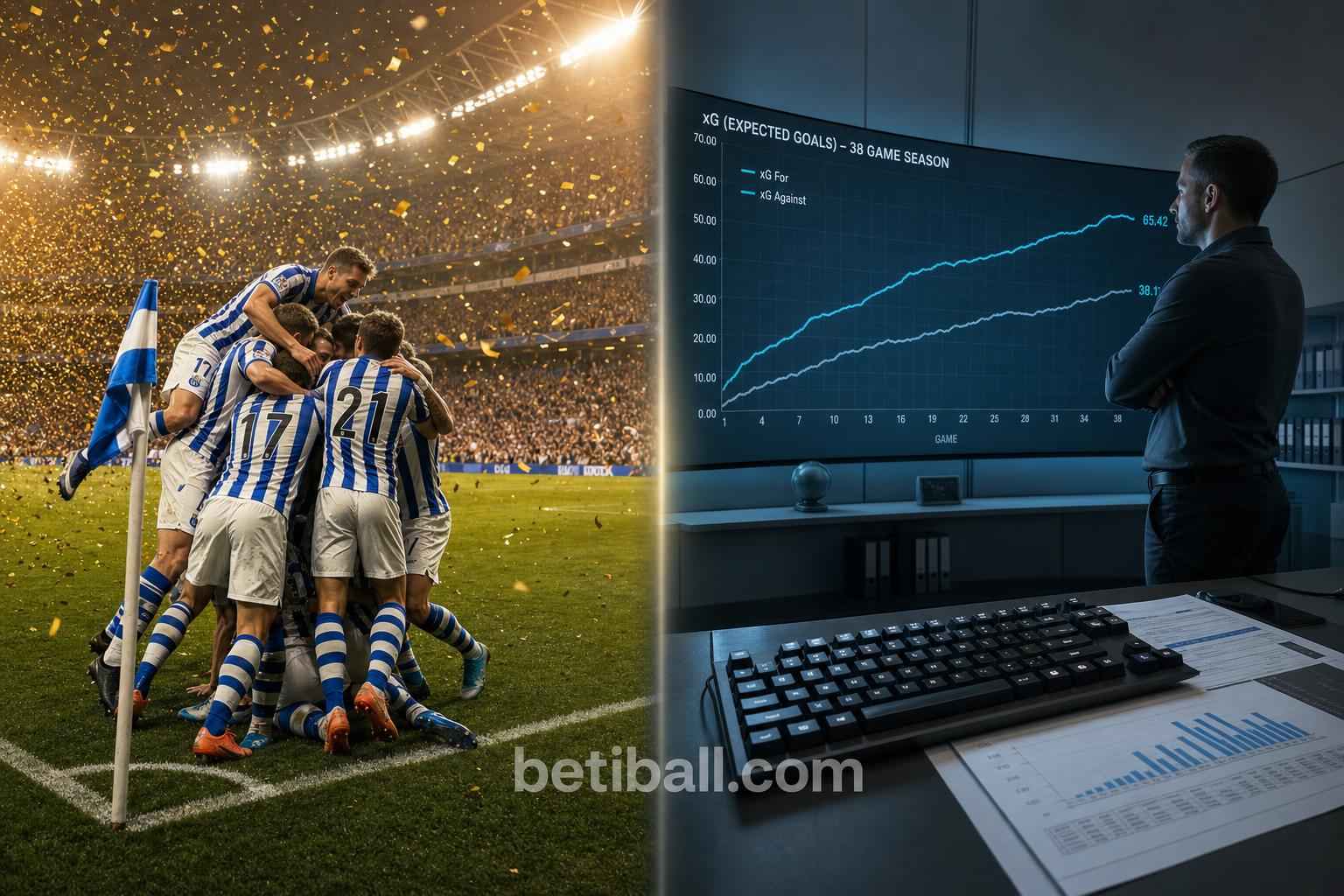
Let's be specific. Consider a Premier League mid-table side that has won four consecutive matches. Across those four games, their average xG per match was 1.1 — meaning they were generating about one genuine scoring chance per ninety minutes. Their opponents' average xG against them was 1.7. They won those four games because their goalkeeper saved three penalties, they scored two goals from outside the box, and they benefited from two red cards for opponents. The underlying statistical profile of that team has not changed. Their defensive structure is the same. Their attacking output is the same. What changed is variance.
Studies of Premier League data over multiple seasons consistently show that form streaks of three to five games have low predictive power for match outcomes beyond that window when xG data is not aligned with results. A 2022 analysis by football analytics researcher Hendrik Schulze, reviewing data from Europe's top five leagues over five seasons, found that teams on winning streaks of four or more games — where actual goals significantly outperformed xG — reverted to their expected win rate within the following four matches in over 73% of cases.
That is the mathematical foundation of the argument: hot streaks built on statistical noise are not sustainable, and betting markets that haven't fully discounted the recency effect create short-term value on the other side.
Form vs Long-Term Stats: Finding the Real Signal
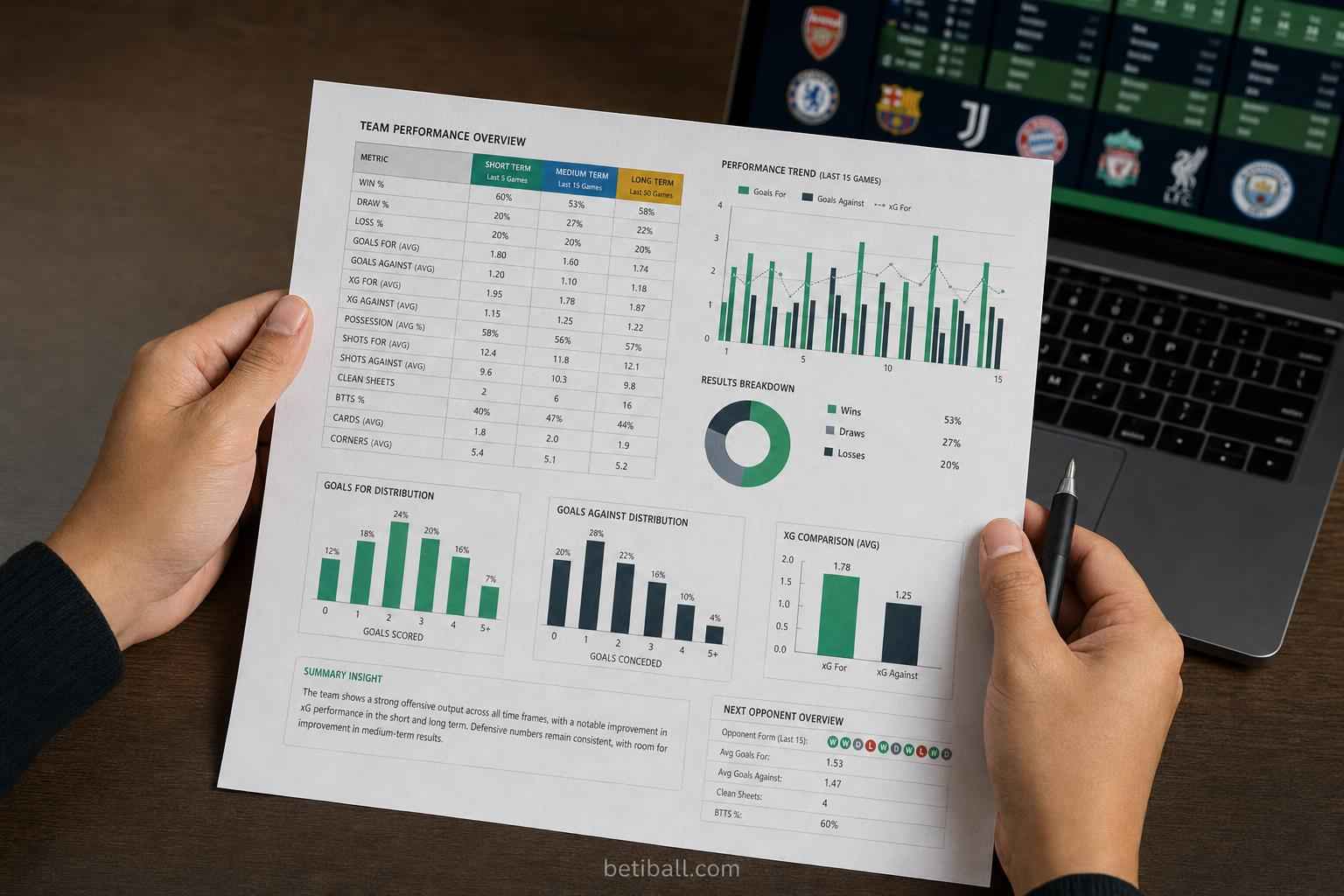
This is not an argument against using form. Recent form contains genuine information. A team that has integrated a new manager, a returning key striker, or a revised defensive shape may perform differently going forward than their 38-game average would suggest. The critical discipline is knowing how to weight form relative to long-term stats.
A practical framework:
- Last 5 matches: Use for tactical pattern recognition and squad health — not for raw win/loss probability.
- Last 15–38 matches: Use for xG-based performance baselines, defensive stability metrics, and home/away differentials.
- Head-to-head over 5+ seasons: Use specifically for identifying structural matchup dynamics — high press vs. deep block, for instance — that tend to persist regardless of current form.
When these layers are in conflict — recent results look good but long-term xG is mediocre — that conflict is your analytical edge. The market will price the recent results. You can price the underlying reality.
The mistake most bettors make is treating form as a shortcut when it should be treated as one variable inside a larger model. Overreacting to recent results doesn't just affect pre-match betting either. It shapes in-play decisions, accumulator selections, and even which leagues bettors follow — with many gravitating toward recently profitable competitions rather than markets they genuinely understand.
The Counter-Argument: Sometimes the Eye Test Is Right
Let's steelman the opposing view, because intellectual honesty matters in analytical betting.
There are situations where recent results are not noise — they are signal. A team that has just appointed a high-press manager and is implementing a new system will often see results precede the data catching up. In the first eight to ten games of a new tactical regime, xG models built on historical patterns may actually underestimate the team's new ceiling because those models are working from old data inputs.
Similarly, player returns from injury — especially central defenders and deep-lying playmakers whose influence is difficult to capture in simple xG metrics — can create genuine performance discontinuities that look like form but are actually structural change.
The nuanced position is this: recency bias becomes dangerous when bettors treat all recent results as signal rather than developing the judgment to distinguish between results-as-noise and results-as-genuine-shift. That judgment comes from combining data with contextual knowledge: lineup changes, tactical shifts, strength of schedule, and the specific conditions of those recent results.
The bettor who ignores recent results entirely is making the opposite mistake — assuming all variance is noise, which is equally wrong. The edge lies in calibration, not in rigid adherence to either extreme.
Practical Steps to Reduce Recency Bias in Your Betting Process
Awareness alone does not fix cognitive bias. You need structural process changes.
1. Always note the xG alongside the scoreline. Before forming any opinion on a result, check whether the winning team outperformed or underperformed their expected goals. A 3-0 win built on 0.9 xG is very different from a 3-0 win built on 2.8 xG.
2. Set a minimum sample size rule. Commit to not drawing form conclusions from fewer than five matches unless there is a verified structural reason — new manager, key transfer, formation shift documented in the press.
3. Track your own betting log by trigger type. Label each bet: was this driven primarily by recent form, long-term stats, or a combination? After 50 bets, review which trigger type has the best ROI. Most bettors discover their recency-triggered bets significantly underperform.
4. Use market movement as a recency detector. If a team's odds shorten sharply following a high-profile win without corresponding team news changes, the market is likely being moved by recency-biased recreational money. That's often a fade opportunity for the informed bettor.
5. Introduce a 24-hour cooling rule for emotionally salient results. If a result surprised you or felt dramatic, wait 24 hours before placing any related bets. Recency bias is amplified by emotional salience — the more memorable a result felt, the more likely you are to overweight it.
Betiball does not accept bets. All examples are for educational purposes only.
Conclusion: The Bettor Who Thinks in Seasons, Not Weekends, Wins
Recency bias in football betting is not a niche problem for beginners. It affects experienced bettors, it shapes entire markets, and it is baked into human cognition in ways that make it genuinely difficult to overcome. The bettors who consistently find value are not those with the most data — they're the ones who have learned how to weight that data correctly across time, resisting the gravitational pull of the last ninety minutes.
Form matters. Context matters. Recent results carry information. But they carry far less information than your brain wants them to, and the market is already pricing in the recency premium. Your edge lives in the longer view.
Read more:

Your feedback helps us deliver better football betting insights.