


 Account
 Language
 Time Zone
 COEF
COEF


Double Chance Betting Football Explained: 1X, X2 and 12
Master double chance betting football with clear examples covering 1X, X2 and 12 markets, probability maths and when each bet offers real value. Explore more on Betiball.
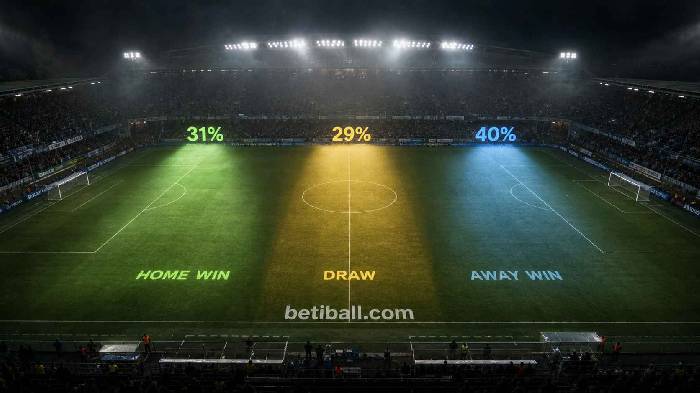


If you have ever hesitated to back an underdog outright or felt that backing a strong favourite at short odds was barely worth the risk, double chance betting football offers a compelling middle ground. By covering two of the three possible match outcomes in a single bet, you trade a lower potential return for a significantly higher probability of winning. This guide breaks down exactly how double chance markets work, when the numbers genuinely support using them, and the mistakes that erode value even when bettors pick the right combination.
What Is Double Chance Betting?
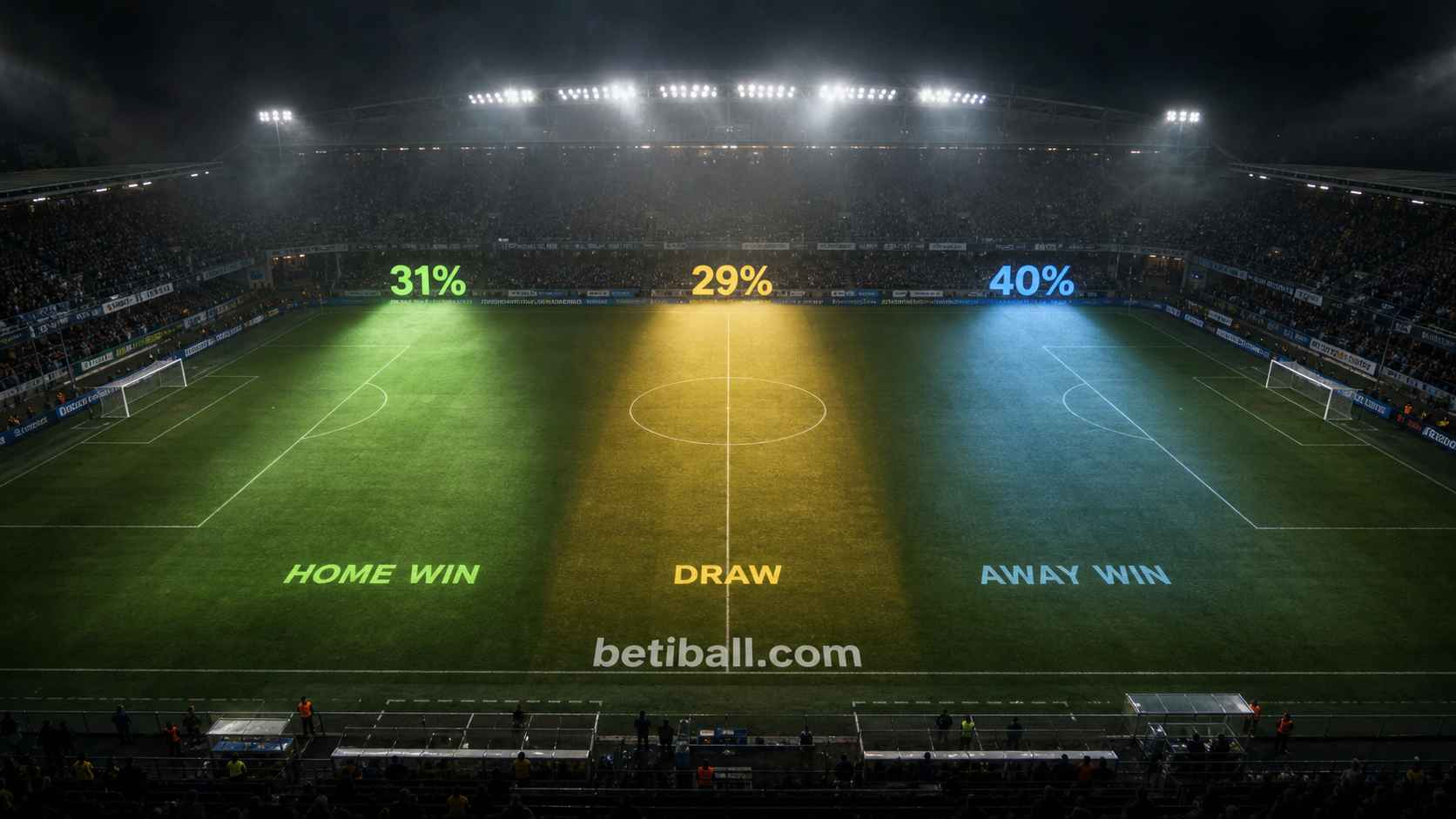
A standard 1X2 market asks you to predict one of three outcomes: home win (1), draw (X), or away win (2). Double chance betting lets you combine two of those outcomes into a single wager. There are three possible combinations:
- 1X – Home win or draw (your bet wins if the home team wins or the match ends level)
- X2 – Draw or away win (your bet wins if the away team wins or the match ends level)
- 12 – Home win or away win (your bet wins as long as there is a decisive result, regardless of which side wins)
Because you are covering two outcomes instead of one, the implied probability of winning is substantially higher. A bookmaker must price the double chance as the combined probability of both underlying outcomes, which is why odds are noticeably shorter than on a straight 1X2 selection. On Betiball, you can filter fixtures specifically by double chance market signals to identify matches where the underlying statistics align with one of these three combinations.
How Double Chance Betting Works: The Mechanics
To understand why double chance odds are priced the way they are, you need to look at how bookmakers derive them from the base 1X2 market. The fair probability of a double chance selection is simply the sum of the individual outcome probabilities.
Suppose a bookmaker's model assigns the following implied probabilities to a match (after stripping out the overround for clarity):
- Home win: 50%
- Draw: 25%
- Away win: 25%
The resulting fair double chance probabilities would be:
- 1X (home win or draw): 50% + 25% = 75%
- X2 (draw or away win): 25% + 25% = 50%
- 12 (home win or away win): 50% + 25% = 75%
In decimal odds, a 75% probability equates to 1.33, and 50% equates to 2.00. Notice that 1X and 12 both sit at 1.33 in this example despite representing different outcome combinations — that only happens when the draw probability and the away win probability are identical. In real fixtures those figures diverge, and so the three combinations produce genuinely different odds.
The margin the bookmaker applies to the 1X2 market is inherited by the double chance market. This means the effective overround on a double chance bet is not lower simply because you cover more outcomes — value still depends on the accuracy of your probability estimate relative to the offered price.

Numeric Example: Reading Real Double Chance Value
Let us work through a concrete example with realistic numbers. Consider a mid-table home side hosting an in-form away team. A statistics platform shows:
- Home team's last ten home matches: 4 wins, 3 draws, 3 losses (40% home win rate)
- Away team's last ten away matches: 3 wins, 4 draws, 3 losses (30% away win rate)
- Head-to-head record over five seasons: 2 home wins, 2 draws, 1 away win
Your model estimates: home win 40%, draw 35%, away win 25%.
Your fair X2 probability: 35% + 25% = 60%, which converts to fair odds of 1.67.
If the bookmaker offers X2 at 1.75, that gap — 1.75 versus your fair 1.67 — represents a positive expected value edge of roughly 4.8%. Over a large sample of similar bets, this edge compounds meaningfully. If the bookmaker prices X2 at 1.55, the bet offers negative expected value despite covering two outcomes, and you should pass.
This is the core discipline: double chance betting is not inherently safer than 1X2 betting. It is only valuable when the offered odds exceed your estimated fair odds. The combination covering two outcomes makes the bet easier to win on any given occasion, but it does not automatically make it profitable.
When to Use Double Chance: Strategic Contexts
Experienced bettors deploy double chance markets in specific tactical situations rather than as a blanket risk-reduction tool. The following scenarios represent genuine strategic use cases.
Strong Away Teams at Short Home Prices
When a top-division away side travels to a struggling home team, the 1X2 market often overprices the home win due to crowd bias and recency weighting. An X2 bet in this context captures both the probable away win and the draw without paying for a home win probability that your model considers inflated.
High-Draw Probability Fixtures
Certain fixture types — derbies, tight Europa League group stage games, promotion playoff legs — have structurally elevated draw rates. When your model identifies a 35% or higher draw probability, 1X or X2 combinations that include the draw become statistically attractive even at compressed odds.
Accumulators Where One Leg Is Uncertain
Using a double chance selection in a multi-leg accumulator for a match where you have moderate conviction preserves the accumulator's viability at the cost of reduced odds on that leg. This is a legitimate variance-management tactic, not a guaranteed return strategy.
12 in Relegation or Cup Elimination Matches
Matches with very high stakes for both sides — relegation six-pointers, cup knockout ties — tend to produce decisive results at an above-average rate. The 12 market, which eliminates the draw, can offer genuine value when both teams are tactically committed to winning.

Common Mistakes in Double Chance Betting
Even analytically minded bettors make systematic errors in this market. These are the most costly ones.
Treating Double Chance as Automatic Value
The most widespread mistake is assuming that covering two outcomes automatically creates value. It does not. Bookmakers price double chance markets directly from their 1X2 model. If you are accepting their implied probabilities uncritically, you are simply locking in their edge across a wider outcome set.
Ignoring Margin Differences Between Books
Because double chance odds are derived from 1X2 prices, the overround on a double chance bet can vary significantly between bookmakers. Line shopping — comparing prices across multiple sources — is as important here as in any other market. A 0.05 difference in decimal odds on a high-volume strategy is material.
Using 1X to Back Dominant Favourites
Backing a strong home favourite with a 1X combination feels safe, but if the home win alone is priced at 1.25, the 1X will sit around 1.10 to 1.12. The return barely justifies the staked capital. In this scenario, your edge — if you have one — is almost entirely in the home win, and the double chance dilutes it severely.
Neglecting Team Motivation and Context
Statistical models work well in aggregate but can miss situational factors. A team with nothing to play for in the final league round behaves differently than its seasonal averages suggest. Always overlay contextual information — squad rotation, cup fixture loading, managerial pressures — before finalising a double chance selection.

Double Chance vs 1X2: Choosing the Right Market
The choice between a double chance and a 1X2 bet should be driven by two variables: your probability estimate for the third excluded outcome and the odds available for each option.
If your model assigns a very low probability to the outcome you are excluding — say, less than 10% — the 1X2 bet almost always offers better expected return per unit staked, because the double chance odds will be heavily compressed relative to the incremental probability gain. Conversely, when the excluded outcome carries 25% or more probability, the double chance provides meaningful insurance that the odds may fairly compensate.
A useful rule of thumb: if the probability of the outcome you are excluding exceeds 20%, evaluate the double chance price carefully. If it does not, you are likely better served by the straight 1X2 selection at higher odds.
Betiball does not accept bets. All examples are for educational purposes only.
Conclusion
Double chance betting is one of the few markets where the gap between casual and analytical bettors is clearly visible. Casual bettors use it to feel safer; analytical bettors use it selectively, when a genuine probability edge exists in covering a second outcome. Understanding the relationship between 1X, X2, 12 and the underlying 1X2 probabilities is the foundation of using this market intelligently. Build your own probability estimates, compare them against available odds, and restrict your double chance activity to fixtures where the numbers genuinely support the combination you choose.
Read more:

Your feedback helps us deliver better football betting insights.