

 Account
 Language
 Time Zone
 COEF
COEF


How to Use a Dropping Odds Tracker to Find Value
Learn how to use dropping odds tracker on Betiball to spot pre-match value through odds movement football signals and sharp market data. Explore more on Betiball.



If you want to move beyond gut instinct and start making data-driven decisions before kick-off, learning how to use a dropping odds tracker is one of the most practical skills you can develop. At Betiball, we built our Dropping Odds Tracker specifically to surface market signals that casual bettors overlook — the kind of sharp, early movement that often reveals where informed money is landing. In this step-by-step tutorial, we walk you through exactly how to read the tool, what the data means, and how to integrate it into your pre-match analysis workflow.

What Are Dropping Odds and Why Do They Matter?
Before you can use the tracker effectively, you need a solid understanding of dropping odds explained in practical terms. Odds represent a bookmaker's probability estimate for a given outcome. When those odds drop — meaning the price shortens — it signals that a significant volume of money has been placed on that selection, forcing the market to adjust.
Not all odds movement is equal. A small drift caused by a casual punter placing a modest stake means very little. But a sharp, sustained drop across multiple bookmakers within a short window — what we call odds movement football traders watch most closely — often indicates that sharp bettors, syndicates, or insiders have acted on information the wider market hasn't yet priced in.
Here is why this matters for your pre-match preparation:
- Consensus drops across five or more major bookmakers carry far more signal weight than a drop at a single operator.
- Speed of movement matters. A 15% drop in under two hours is more significant than the same drop spread over three days.
- Timing relative to kick-off is critical. Drops in the final 12 hours before a match frequently reflect team news, injury updates, or tactical changes.
Understanding these mechanics is the foundation for everything else in this guide.

How to Navigate Betiball's Dropping Odds Tracker
Our tracker is designed to be intuitive, but a structured walkthrough ensures you extract maximum value from every session. Follow these steps:
Step 1: Access the Dropping Odds Section
From the Betiball homepage, navigate to the Statistics menu in the top navigation bar. Select Dropping Odds from the dropdown. You will land on a live-updating dashboard displaying all tracked matches across major European and global leagues.
Step 2: Set Your League and Time Filters
By default, the tracker displays all available leagues. Use the left-hand filter panel to narrow results by competition — for example, Premier League, La Liga, Bundesliga, or Serie A. Next, apply a time filter. We recommend filtering for matches kicking off within the next 6 to 24 hours to focus on actionable, near-term movement rather than early noise.
Step 3: Read the Odds Movement Columns
Each row in the tracker shows a match alongside its opening odds, current odds, and the percentage change for the 1X2 market. A red downward arrow indicates a meaningful drop. Pay close attention to the % Drop column — our threshold for significant movement is a drop of 10% or greater within a 24-hour window.
Step 4: Cross-Reference with the Match Statistics Page
Never act on odds movement in isolation. Click the match name to open the full statistics page. Review head-to-head records, recent form (last five matches), home and away performance splits, and any available team news. Movement that aligns with strong underlying statistics carries a higher confidence level.
Step 5: Check the Odds History Graph
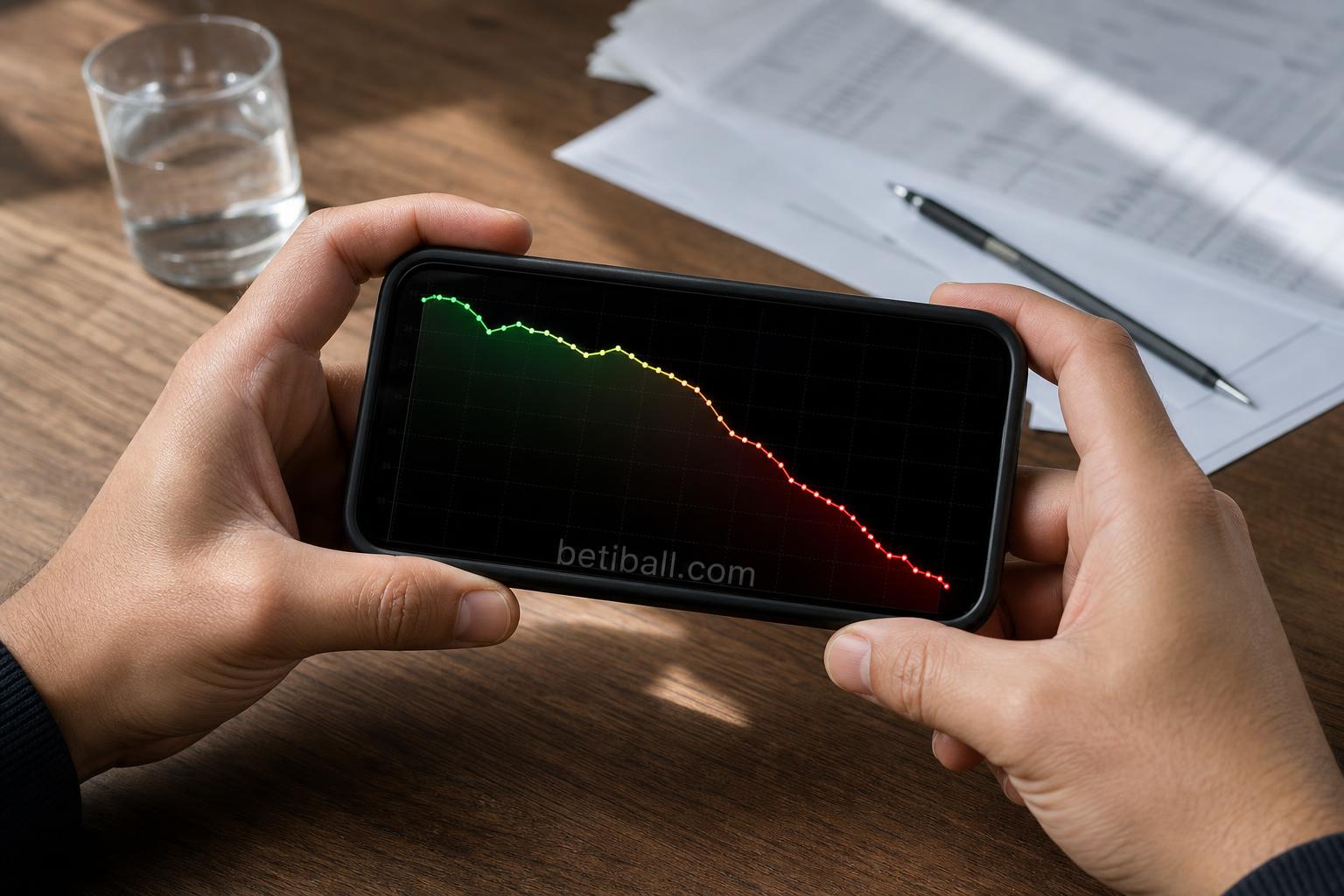
Every tracked match includes an Odds History Graph accessible via the chart icon on the right of each row. This visualises the complete price trajectory from market opening to the present moment. Look for sharp, vertical drops rather than gradual drifts — these are the clearest indicators of deliberate, informed market activity.
How to Interpret the Signals You Find
Reading the tracker is a mechanical skill. Interpreting what you find requires analytical judgment. Here is how we approach signal validation at Betiball:
Step 1: Distinguish Market Correction from Sharp Action
Sometimes odds drop simply because a bookmaker opened a line too generously and is correcting to the market consensus. To distinguish this from genuine sharp action, compare the movement across at least three to four different operators. If only one bookmaker has dropped while others remain static, you are likely looking at a correction. If four or more have dropped simultaneously, that is a stronger signal.
Step 2: Combine Dropping Odds with Form Data
Apply what we call the double confirmation rule: a dropping odds signal is only worth close attention when it aligns with supporting statistical evidence. For example, if the away win odds are dropping sharply and the statistics page shows the away side has won their last four on the road while the home team has lost three of their last five at home, the convergence of both signals adds meaningful confidence.
Step 3: Flag and Monitor Over Time
Use the bookmark icon next to each match to add it to your watchlist. Revisit flagged matches at two-hour intervals in the lead-up to kick-off. Progressive drops that continue into the final hour before the match often represent the strongest signal category we track, as they suggest sustained, cumulative positioning rather than a single spike.
Common Mistakes to Avoid When Using Dropping Odds Data
Even experienced analysts make errors when first incorporating use dropping odds betting strategies into their workflow. Here are the most frequent pitfalls:
Mistake 1: Treating Every Drop as Actionable
Volume matters. A 5% drop on a low-liquidity lower-league match may reflect a single large stake rather than genuine sharp market movement. Restrict your primary focus to matches in high-liquidity leagues where the market depth means drops require substantial cumulative volume to occur.
Mistake 2: Ignoring the Direction of the Drop
A drop on the home win does not automatically mean the home side will win — it means the market is moving toward that outcome based on current information. Always ask: what has changed? Check our news and team update sections for injury announcements, suspended players, or confirmed tactical shifts that might explain the movement.
Mistake 3: Using Dropping Odds as Your Only Signal
The tracker is a discovery tool, not a standalone decision framework. It tells you where to look, not what to conclude. Always combine dropping odds data with our full statistical suite — form tables, expected goals data, head-to-head records, and Betiball's pre-match predictions — before forming any view.

Building a Consistent Pre-Match Analysis Routine
The analysts and data team here at Betiball recommend establishing a structured daily routine that incorporates the Dropping Odds Tracker as one layer within a broader pre-match workflow. Here is the routine we suggest for serious football bettors:
Step 1: Morning Scan (24 Hours Before Kick-Off)
Run a full scan of all matches kicking off the following day. Identify any selections already showing drops of 8% or more. Bookmark these matches and note the current odds and percentage drop as your baseline. This establishes your reference point for monitoring movement over the day.
Step 2: Afternoon Deep-Dive (12 Hours Before Kick-Off)
Return to your bookmarked matches. Have the drops continued or reversed? Cross-reference with any team news published since your morning scan. Check our statistics pages for each flagged match and apply the double confirmation rule outlined in the previous section.
Step 3: Final Review (2 Hours Before Kick-Off)
This is your highest-signal window. Filter the tracker specifically for matches within two hours of kick-off. Any selections showing continued or accelerating drops at this stage — particularly in conjunction with strong statistical backing — represent the highest-confidence pre-match signals our tracker can surface.
Consistency in this routine, applied over a meaningful sample size of matches, is what separates analysts who extract genuine edge from the data versus those who act on isolated signals without context.
Betiball does not accept bets. All examples are for educational purposes only.
You Are Now Ready to Use Betiball's Dropping Odds Tracker
You are now ready to integrate one of the most powerful pre-match tools in our platform into your regular analysis process. You understand what dropping odds are, why they matter, how to navigate and read our tracker, how to validate the signals you find, and how to build a consistent daily routine around the data. The Dropping Odds Tracker does not predict outcomes — no tool can do that with certainty. What it does is reveal where informed market participants are positioning, giving you a structured, data-backed starting point for every pre-match decision you make.
Read more:

Your feedback helps us deliver better football betting insights.