


 Account
 Language
 Time Zone
 COEF
COEF


Head-to-Head Records in Football Betting: Do They Matter?
Discover how head to head records football betting should really influence your strategy. H2H vs form, data tables, and expert tips. Explore more on Betiball.


When serious bettors research a fixture, head to head records football betting analysis is often the first stop. Pull up any major match preview and H2H data sits front and centre — five meetings, seven meetings, sometimes a decade of results condensed into a table. But here is the question most bettors never stop to ask: does that historical record actually predict what happens on Saturday, or is it statistical noise dressed up as insight? On Betiball, we process millions of data points across Europe's top leagues, and the answer is more nuanced — and more useful — than most tipsters admit.

What Are Head-to-Head Records and Why Do Bettors Rely on Them?
H2H football stats refer to the historical results, goals scored, and performance metrics between two specific clubs across their previous meetings. Bettors use them for a simple reason: patterns feel predictive. If Chelsea have won six of the last eight home fixtures against Arsenal, that creates a psychological anchor — an expectation that the pattern continues.
The appeal is understandable. H2H data is tangible, historically grounded, and easy to read. It feels like evidence. Sportsbooks know this too, which is part of why H2H tables are prominently displayed on their platforms — engaged bettors spend more time on site and, in many cases, trust visible patterns over invisible probabilities.
But relying on H2H alone conflates two very different things: historical facts and future probability. A result that occurred three years ago involved different squads, different managers, different tactical systems, and different situational contexts. The team badge may be the same; the sporting entity is often substantially different.

Does H2H Actually Predict Match Outcomes? What the Data Shows
To properly answer does H2H matter betting, we need to move beyond anecdote and look at what statistical modelling tells us. Academic researchers and quant-focused sports analysts have studied the predictive power of H2H records extensively, and the consensus findings are instructive.
A widely cited approach in football modelling (Dixon and Coles, 1997; subsequent refinements by Rue and Salvesen, 2000) applies Poisson regression to goal expectation modelling. When H2H variables are added to models that already include current-season form, Elo ratings, and home advantage, the incremental predictive improvement from H2H data is statistically marginal in most fixture types.
The critical qualifier is sample size. Most club pairings in domestic leagues meet twice per season. Over a ten-year span, that produces roughly 20 data points — and many of those are rendered unreliable by manager changes, promotion/relegation cycles, or squad overhauls. Twenty data points, many of which are contextually stale, is not a robust statistical foundation.
However, H2H data does carry measurable weight in specific circumstances:
- Rivalry fixtures with stable tactical identity: Clubs that maintain consistent playing styles across coaching changes (Atletico Madrid's defensive compactness, for example) produce H2H records that remain relevant longer.
- Cup fixtures between sides from different divisions: Where form guides are structurally incompatible, H2H can serve as a useful proxy.
- High-volume meeting pairs: International fixtures like El Clásico or the Superclásico accumulate enough meetings to generate statistically meaningful signals.
H2H vs Form: A Comparative Data Table
| Factor | Predictive Weight (Typical Model) | Reliability Timeframe | Best Use Case |
|---|---|---|---|
| Current Form (Last 5–6 games) | High (primary signal) | Immediate — 4–8 weeks | All fixture types |
| Home/Away Performance Split | High (strong secondary signal) | Current season | All fixture types |
| H2H Record (Last 5 meetings) | Low–Medium | 2–3 years maximum | Derby/rivalry matches; tactically stable clubs |
| H2H Record (Last 10+ meetings) | Low (diminishing returns) | Often contextually stale | High-volume fixture pairs only |
| Elo / Power Ratings | High (cumulative signal) | Rolling — continuously updated | All fixture types, especially long-range |
| Expected Goals (xG) Trend | Very High (process metric) | Current season (minimum 6 games) | All fixture types — undervalued by market |
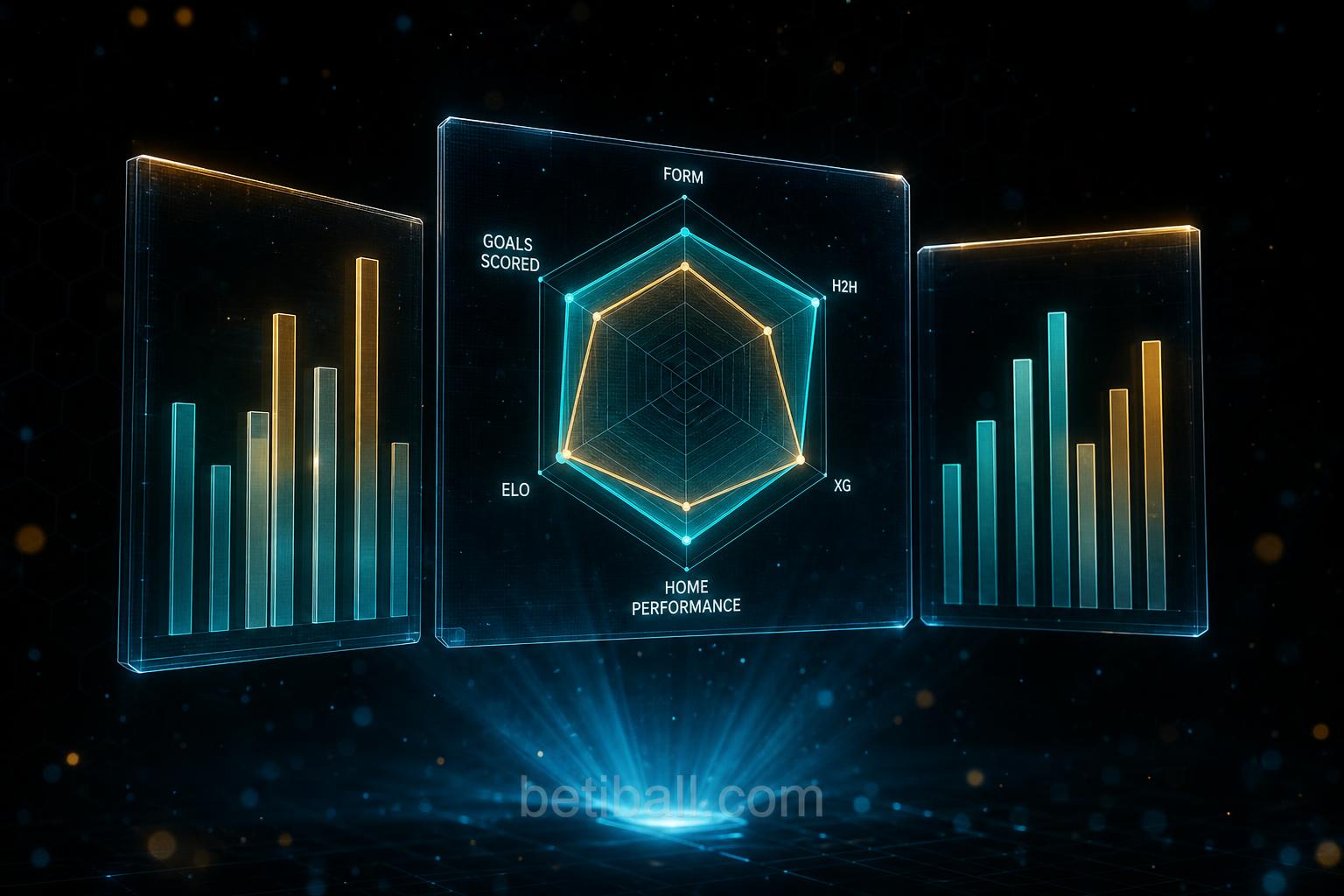
Head to Head vs Form: Which Signal Should Dominate Your Analysis?
The head to head vs form debate is not binary — experienced bettors understand that good football analysis is about correctly weighting multiple signals, not finding a single magic variable. That said, when the two conflict, the evidence strongly favours prioritising current form for the majority of fixtures.
Here is why. Form reflects the current sporting reality of a club: their fitness levels, tactical cohesion under the present manager, injury profile, and psychological momentum. A team that has won five consecutive matches has done so with today's personnel executing today's system. A H2H record from 2020 tells you about a different tactical setup, probably different key players, and a different mental landscape entirely.
The exception — and it is worth emphasising — is when H2H data and current form point in the same direction. Confluence of signals is where analytical bettors should pay close attention. If Team A leads the H2H record over the last four meetings and carries superior current form, xG metrics, and home advantage, the probability case becomes compellingly strong.
Conversely, if a strong H2H record contradicts poor current form, the bettor faces a genuine signal conflict. In this scenario, a process-focused approach — one that weights xG, defensive metrics, and recent results above historical pattern — will outperform naive H2H reliance over a large sample of bets.
How to Practically Apply H2H Data in Your Betting Research
Given everything above, here is a structured framework for incorporating H2H football stats into your betting research without over-weighting them:
1. Apply a Recency Filter
Limit H2H analysis to meetings within the last three years, and cross-reference each result against whether the current manager was in charge at the time. If more than half the H2H meetings predate the current coaching regime of either club, discount the record significantly.
2. Check for Structural Factors
Certain H2H records are not random — they reflect genuine structural advantages. These include: a club's dominant physical style exploiting a specific opponent's weakness, pronounced home fortress records, or psychological fragility in high-pressure derbies. These structural factors are worth respecting in your model.
3. Use H2H as a Tiebreaker, Not a Lead Signal
When your primary analysis (form, xG, fitness, tactical matchup) produces a genuinely uncertain picture — say, a 50/50 call — H2H can serve as a legitimate tiebreaker. In close-margin analysis, even a low-weight variable can shift the probability estimate enough to move you toward or away from a value bet.
4. Look Beyond Results to Process Metrics
Modern H2H analysis should go beyond win/loss/draw. On platforms like Betiball, you can access historical xG data, possession splits, and shots on target from previous meetings. If Team A has consistently generated higher xG in H2H fixtures despite a mixed win record, they may be systematically undervalued in the market.
5. Combine H2H With Market Movement
If heavy public betting on a clear H2H favourite is moving the line significantly, sharp bettors often find value on the other side — particularly when the H2H narrative is stale and the underlying form metrics favour the underdog. The market's over-reliance on visible H2H patterns can create exploitable inefficiencies.

The Psychological Trap: Why H2H Feels More Predictive Than It Is
There is a behavioural reason why bettors systematically over-weight H2H records, and understanding it is as important as understanding the statistics. Cognitive psychology identifies this as representativeness bias — the tendency to weight vivid, narrative-rich evidence (six straight defeats in this fixture) over abstract probabilistic evidence (underlying xG difference of 0.3 per game).
H2H records tell a story. Stories are cognitively compelling. An xG trend line is not a story — it is a process signal. Human brains are wired to favour the story, which is precisely why bookmakers surface H2H data so prominently. It anchors bettors to narrative-driven decisions rather than probability-driven ones.
The analytical bettor's edge is not superior information in most cases — it is superior processing of available information. Consciously downgrading the psychological pull of H2H narratives while rigorously applying form-based and process-based metrics is a systematic advantage over the average recreational bettor who takes the H2H table at face value.
Conclusion: Use H2H as One Layer, Not the Foundation
Head-to-head records in football betting are a legitimate analytical tool — but they are a supporting actor, not the lead. For most fixtures, current form, home/away metrics, xG trends, and squad fitness will outperform H2H records as predictive variables. The situations where H2H deserves genuine weight are specific: rivalry matches with tactically stable clubs, high-volume fixture pairs, and cases where H2H data confirms — rather than contradicts — your primary analysis.
The most dangerous approach is treating a compelling H2H narrative as a betting reason in itself. The most effective approach is treating H2H as one layer in a multi-signal model, processed without cognitive bias, and cross-referenced against the metrics that reflect the current sporting reality of both clubs.
Betiball gives you access to the full data stack — H2H records, xG histories, form guides, and more — so you can make the kind of evidence-based decisions that hold up across a long betting season.
Betiball does not accept bets. All examples are for educational purposes only.
Read more: