




































Half Time / Full Time Betting Explained: HT/FT Strategy Guide
Master half time full time betting with our complete HT FT guide. Learn how double result football bets work, when they offer value. Explore more on Betiball.

If you've spent any time studying football betting markets, you've likely come across the half time full time betting option — sometimes called the double result or HT/FT bet. It looks straightforward on the surface, but it rewards analytical bettors who understand momentum shifts, team psychology, and how odds are priced. This guide breaks down exactly how the HT FT bet works, when it offers genuine value, and the mistakes that drain bankrolls on what should be a high-edge market.
All match data, historical head-to-head records, and team form statistics referenced throughout this article are available through Betiball, where you can filter fixtures by competition, form streak, and specific betting markets.
What Is Half Time / Full Time Betting?
A half time full time bet — also written as HT/FT — is a double result wager that asks you to correctly predict both the result at half time and the final result at full time. You're essentially staking on two outcomes within a single selection.
Each possible combination is priced as its own market. In a standard football match, there are three possible half time results (Home Win, Draw, Away Win) and three possible full time results, generating nine distinct HT/FT combinations:
- Home / Home
- Home / Draw
- Home / Away
- Draw / Home
- Draw / Draw
- Draw / Away
- Away / Home
- Away / Draw
- Away / Away
The notation follows the format HT result / FT result. A "Draw / Home" selection means the match is level at half time but the home side wins by full time — a comeback scenario. This is fundamentally different from simply backing a home win on the 1X2 market, because you're also committing to how the scoreline reads at the interval.
The added precision is why the odds are considerably higher than standard match result odds. You're correct on two variables, not one.
How the HT FT Bet Works: Mechanics and Odds Structure
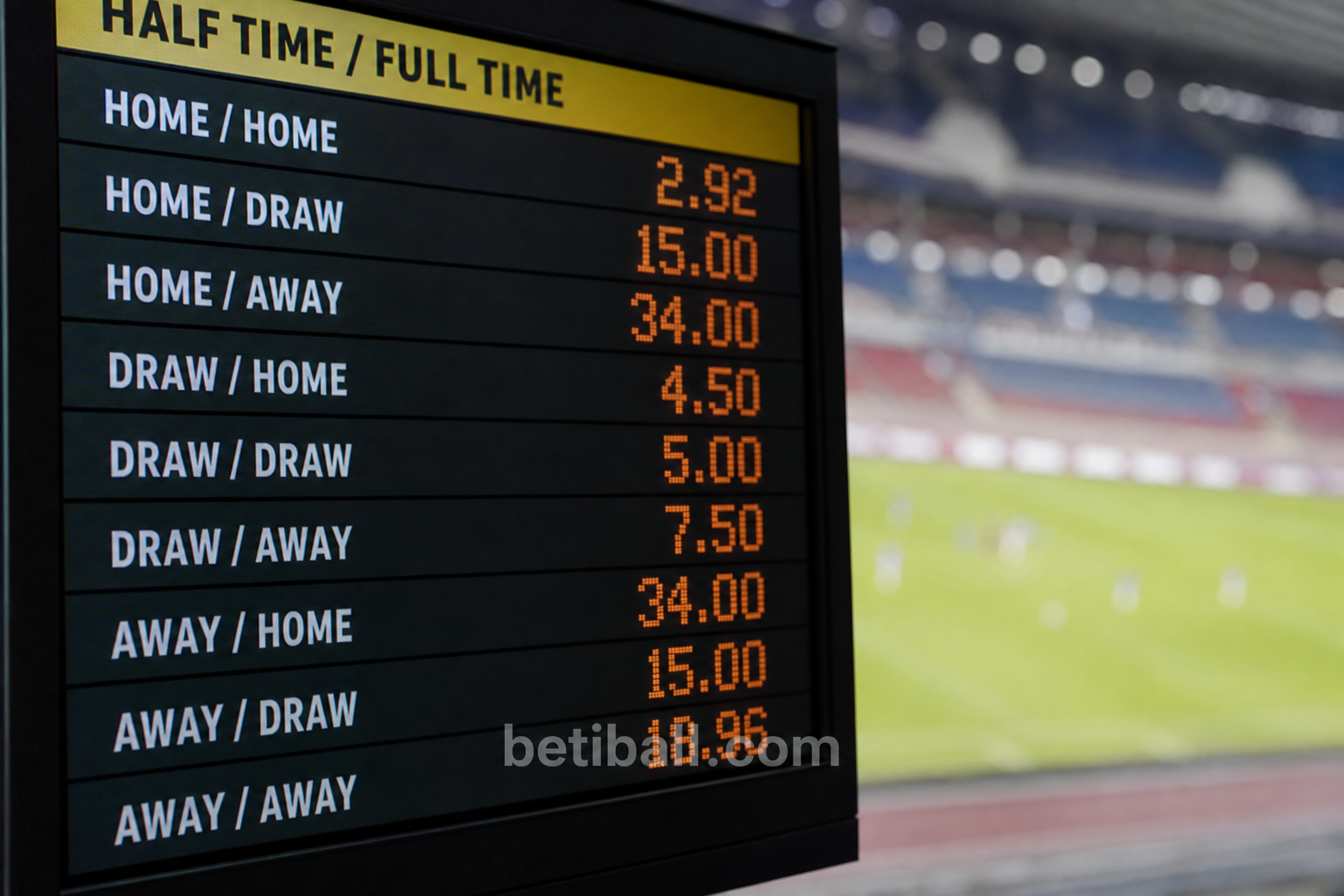
Bookmakers price HT/FT markets by calculating the joint probability of two correlated outcomes. Because the two results are not independent — a 0-0 scoreline at half time significantly reduces the probability of a high-scoring full-time result — the pricing process is more complex than simply multiplying two separate match-odds probabilities.
In practice, this means the market margin (the bookmaker's edge) is often higher in HT/FT markets than in 1X2 markets. A well-informed bettor can still find value, but only if they identify specific structural inefficiencies — typically around teams with consistent half-time vs. full-time behavioral patterns.
Key variables bookmakers factor into HT/FT pricing include:
- First-half and second-half goal distribution for both teams
- Home and away form splits
- In-game tactical tendencies (pressing intensity by period, defensive shape)
- Historical HT/FT conversion rates
From a bettor's perspective, identifying teams that regularly produce the same HT/FT pattern is where the analytical edge lives.
Numeric Example: Breaking Down an HT/FT Wager
Let's walk through a real-world scenario to make the mechanics concrete.
Suppose Manchester City are hosting a mid-table side. The 1X2 market prices City as heavy favourites at 1.40 to win the match. However, the Draw / Home HT/FT option — meaning the game is level at the break but City win by full time — is priced at 4.50.
Statistical context: over the past two seasons, City drew or trailed at half time in roughly 35% of their home fixtures, yet won the match in 78% of those cases. That suggests the historical probability of a Draw/Home outcome in this specific context is approximately 0.35 × 0.78 = 27.3%, implying fair odds of around 3.66.
At 4.50, the bookmaker is offering implied odds of 22.2% — if the true probability is closer to 27%, the expected value (EV) on this selection is positive. That gap between market-implied probability and your estimated probability is precisely where half time result betting becomes profitable over a large sample.
This is not guesswork. It requires:
- A reliable dataset of first-half and second-half results by team
- Consistent model inputs (same competition, home/away context)
- Discipline to only bet when the edge clears a meaningful threshold
Using Betiball's historical form filters, you can pull exactly this kind of period-specific data before placing any double result football wager.
When HT/FT Bets Offer Real Value

Not every fixture is a candidate for HT/FT betting. The market rewards specificity. The highest-value scenarios tend to fall into four categories:
1. Teams With Strong Second-Half Comebacks
Certain managers systematically adjust at half time. Teams like these show a measurable pattern of trailing or drawing at the interval, then winning. The Draw/Home or Away/Home options will often be overpriced by bookmakers who weight the first-half data less heavily than the full-match trend.
2. Dominant Teams Against Defensive Opposition
When a top-six side faces a team that parks defensively, early breaks and low half-time scores are statistically common. The Draw/Home combination may offer better odds than the raw match-winner price, while carrying a comparable probability based on historical similar matchups.
3. Low-Table Survival Clashes
Relegation six-pointers between struggling teams frequently produce tense, tight first halves followed by a goal when one side commits forward in desperation. The Draw/Away or Draw/Home outcomes in these fixtures are often underestimated by the market.
4. Cup Fixtures with Rotated Squads
Early-round cup games often feature weaker elevens in the first half, with stronger substitutes introduced at the break. The structural pattern here can produce consistent HT/FT anomalies — though sample sizes are smaller and should be used with caution.
Common Mistakes Bettors Make on HT/FT Markets

The elevated odds in half time full time betting attract recreational bettors who see big numbers and bet without a structural reason. These are the most frequent and costly errors:
Backing Heavy Favourites to Lead at Half Time AND Win
The Home/Home combination on a strong favourite looks safe. But because the first-half advantage is already priced in, the combined odds often represent poor value. The implied probability can exceed the true probability simply because the most obvious selection attracts the most money.
Chasing Accumulator-Style Payouts
Some bettors string multiple HT/FT selections into a parlay chasing headline odds. Each leg compounds both the margin and the variance. Unless each individual selection carries a positive edge, the combined EV deteriorates rapidly.
Ignoring First-Half Goal Data
Using only full-time statistics to inform an HT/FT pick is a fundamental research error. You need period-specific data — first-half shots, first-half xG, early goal concession rates. These are distinct from the full-match equivalents and often tell a different story.
Overvaluing Recent Form in Isolation
A team on a five-match winning streak still has a measurable probability of being level at half time. Ignoring the base rate of HT/FT patterns in favour of narrative-driven form analysis leads to systematic miscalibration.
Neglecting Market Movement
Sharp money on HT/FT markets moves odds quickly. If a Draw/Home selection opens at 4.50 and drops to 3.80 before kickoff, that signals informed money — and the value window may have closed before you acted.
Betiball does not accept bets. All examples are for educational purposes only.
Conclusion: Treat HT/FT as a Data-Led Market, Not a Lottery
The double result football market is not designed for casual punters hoping to multiply their stake with a lucky guess. It is a precision instrument. Used with rigorous period-specific data, a clear model for team behavioral patterns, and strict edge requirements before placing a bet, the HT/FT market offers opportunities that the standard 1X2 market frequently cannot match.
The analytical foundation for every selection should be measurable, repeatable, and documented. Use Betiball's match statistics and form filters to build that foundation before committing to any half time result betting selection — and treat every wager as a test of your model, not a test of your luck.
Read more: