







































Corners Betting Football Guide: Predict Counts With Stats
Master corners betting football guide with stats-backed strategies for over under corners and corner market football analysis. Explore more on Betiball.


The corners betting football guide you've been looking for starts here. Corner kicks are one of the most data-rich bet types in modern football wagering — yet most recreational bettors treat them as an afterthought. If you approach corner markets with the same analytical discipline you'd apply to match result betting, you'll find consistent edges that many sportsbooks undervalue. Betiball aggregates the statistics that make this kind of analysis possible, from team-level corner averages to head-to-head corner trends across leagues worldwide.
This guide breaks down corner kick betting from the foundational mechanics all the way through to data-driven strategy. Whether you're new to corner markets or looking to sharpen an existing approach, you'll leave with a structured framework for making better-informed decisions.

Who This Guide Is For
This guide is written for serious football bettors who already understand basic wagering concepts and want to move beyond straightforward 1X2 markets. Specifically, you'll benefit most if you:
- Already track match statistics and look for value in specific bet types
- Want to diversify beyond goals-based markets into event-count betting
- Are building or refining a data-backed betting system
- Understand that no prediction tool guarantees returns, but believe statistical models outperform guesswork
If you're completely new to sports betting, we recommend familiarizing yourself with basic football betting structures before diving deep into corner markets. For everyone else, let's get into the numbers.
The Basics of Corner Kick Betting
Corner kick betting — sometimes called the corner market football segment — revolves around predicting the total number of corners taken during a match, either by both teams combined or by individual teams. The most common formats you'll encounter are:
Over/Under Corners
The over under corners market is the most popular entry point. Bookmakers set a line — typically between 9.5 and 11.5 for top European leagues — and you bet on whether the actual corner count will exceed or fall short of that number. A line of 10.5 means you need 11 or more corners for an "over" to land.
Asian Handicap Corners
Similar to goal-based Asian handicaps, this market assigns a corner handicap to one team. For example, Team A -2.5 corners means Team A must win the corner count by three or more for the bet to succeed. This market rewards teams with strong attacking width and high crossing tendencies.
First Half vs. Full Match Corners
Many operators split corner markets by half. First-half corner totals typically run between 4.5 and 5.5. These shorter windows are more volatile but offer opportunities when you've identified teams that start aggressively or tend to park the bus after the break.
Team-Specific Corner Bets
Rather than focusing on total match corners, some markets let you bet on how many corners one specific team will earn. This is particularly useful when a strong attacking team faces a low defensive block, which tends to generate high individual corner counts for the attacking side.
Advanced Statistics That Drive Corner Predictions
Raw corner averages are a starting point, but serious corner betting requires layering multiple statistical indicators. Here's what to look for:
Corners Per Game (CPG) Average
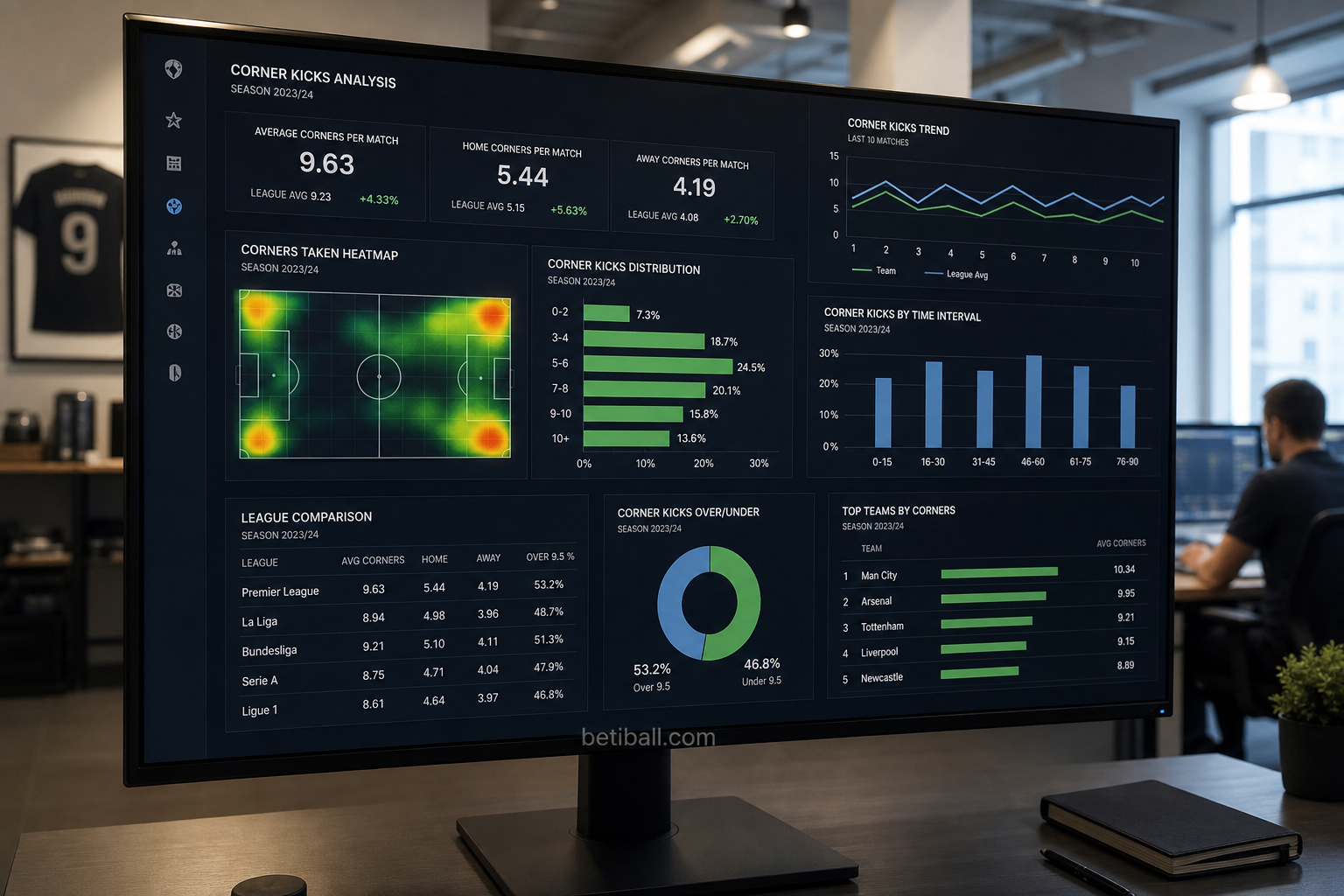
Every team has an average corners won per match and an average corners conceded per match. These figures should be split into home and away performances, as teams frequently defend differently on the road. A team averaging 7.2 corners at home may average only 4.8 away from home — a significant difference that a blended season average will obscure.
Attacking Width and Cross Rate
Teams that rely on wide attackers and deliver high volumes of crosses naturally generate more corners. Check how many of a team's attacks originate from wide positions — this metric, available on platforms like Betiball's match filter pages, correlates strongly with corner counts.
Defensive Shape and Press Intensity
A deep defensive block forces more crosses and shots from angles, producing corners. High-press teams that win the ball high up the pitch often generate fewer corners for their opponents because they interrupt wide attacks before they develop.
Match Stakes and Game State
Scoreline and game state matter enormously. When a team is losing, it tends to push bodies forward, creating more attacking corners for themselves while conceding on the break. High-pressure fixtures late in a season — relegation battles, title deciders — often produce elevated corner counts as teams chase goals.
Referee Tendency
Some referees award significantly more corners than others due to marginal out-of-play decisions. While this data is harder to access consistently, it adds a meaningful refinement layer for bettors operating at a more granular level.
League-Level Baselines
Corner averages vary dramatically by league. The Premier League and Bundesliga both average approximately 10-11 corners per match at league level, while some lower-tempo leagues in Southern Europe average 8-9. Never apply a single global benchmark across all competitions.

Strategy Tips and Pre-Match Checklist
Armed with the right data points, you can build a consistent pre-match evaluation process. The following checklist table outlines the key variables to assess before placing any corner market bet.
Corner Betting Pre-Match Checklist
| Factor | What to Check | Impact on Corner Total |
|---|---|---|
| Home team CPG (home) | Corners won per home match this season | High = pushes total up |
| Away team CPG (away) | Corners won per away match this season | High = pushes total up |
| Home team corners conceded (home) | Corners allowed per home match | High = pushes total up |
| Away team corners conceded (away) | Corners allowed per away match | High = pushes total up |
| Head-to-head corner history | Last 5 H2H meetings corner counts | Consistent patterns useful |
| League average corners per match | Season-to-date league baseline | Sets expected range |
| Attacking width profile | % of attacks from wide zones | High % = more corners likely |
| Defensive block depth | Average defensive line height | Deep block = more corners |
| Match importance / game state likelihood | Is one team likely to chase the game? | Chasing team = more corners |
| Weather conditions | Heavy wind or rain forecast | Wind increases aerial play; mixed effects |
Practical Strategy Notes
Build a projected corner total. Using CPG data, calculate an expected match corner count by adding: (home team CPG at home) + (away team CPG away) and comparing that sum against the bookmaker's line. If your model projects 11.2 corners and the line sits at 10.5, the over has positive expected value based on your inputs.
Focus on markets where you have an edge over the line. Don't bet every corner market just because you've run the numbers. Look for mismatches between your projection and the bookmaker's line. Lines on lower-profile league matches and in-play corner markets tend to be softer than those on high-profile fixtures.
Separate first-half and full-match strategies. Some teams are known for fast starts and high early corner counts. If your data shows a team averages 5.8 first-half corners at home but the bookmaker's first-half line is set at 4.5, that represents a potential edge worth exploring independently of the full-match total.
Avoid emotional overlays. The corner market is purely statistical. The quality of the football, the entertainment value of the fixture, or fan expectations are irrelevant inputs. Strip the analysis back to team-level and match-level data every time.

Using Betiball's Data Tools for Corner Analysis
Building a corner betting model from scratch requires reliable, up-to-date data. Betiball's market filter pages allow you to sort and compare teams by corner statistics across multiple leagues and time frames. You can identify high-corner matchups, track team trends over rolling windows (last 5, last 10, season), and cross-reference head-to-head data — all in one place.
For corner betting specifically, the most valuable filters are:
- Team corner average split by home/away — essential for avoiding blended-average distortions
- Opposition corner conceded averages — lets you profile how a defensive team will affect the total
- League corner benchmarks — provides the baseline for over/under line evaluation
- Head-to-head match history — useful for identifying fixture-specific patterns between recurring opponents
The more consistently you apply a structured data process before each bet, the less your decision-making will be influenced by recency bias, media narrative, or gut feeling — the three biggest enemies of long-term profitability in corner markets.
Betiball does not accept bets. All examples are for educational purposes only.
Conclusion
Corner kick betting rewards analytical bettors who are willing to go beyond surface-level statistics. By understanding team-specific corner tendencies, league baselines, attacking width profiles, and how game states influence corner counts, you can build projections that consistently challenge bookmaker lines. Use the pre-match checklist above as your standard evaluation framework, layer in head-to-head data where relevant, and only commit to bets where your model identifies a genuine edge over the market.
The corner market is one of the most underanalyzed segments in football betting — which is exactly why it remains an opportunity for data-driven bettors who do the work.
Read more: