

 Account
 Language
 Time Zone
 COEF
COEF


Pressing Tactics in Football: High Press, Gegenpressing & How They Affect Scores
Master football pressing tactics explained — high press, gegenpressing meaning, and pressing intensity data that shapes match outcomes. Explore more on Betiball.
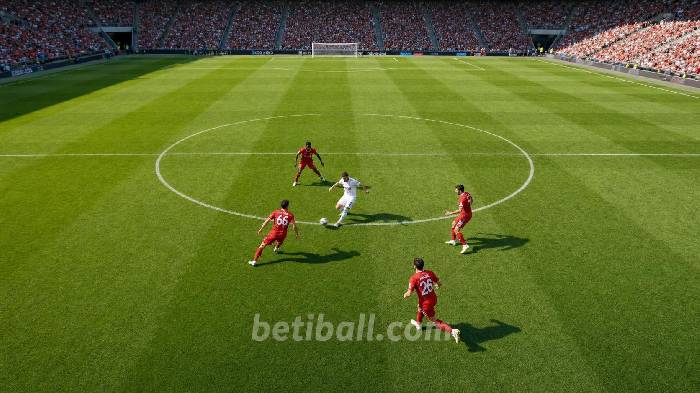


Understanding football pressing tactics explained in clear, analytical terms is essential for anyone who wants to read matches more deeply — whether you are a committed football analyst or a serious bettor looking for an edge. Pressing has reshaped modern football from grassroots level all the way to the Champions League, influencing scorelines, xG numbers, and in-play momentum in ways that raw league tables simply cannot capture. At Betiball, we track pressing metrics across Europe's top five leagues every week, and the patterns we find consistently challenge conventional pre-match assumptions. In this deep-dive guide, we break down what pressing actually is, how gegenpressing differs from a structured high press, and — most importantly — how pressing intensity translates into measurable match outcomes you can use.
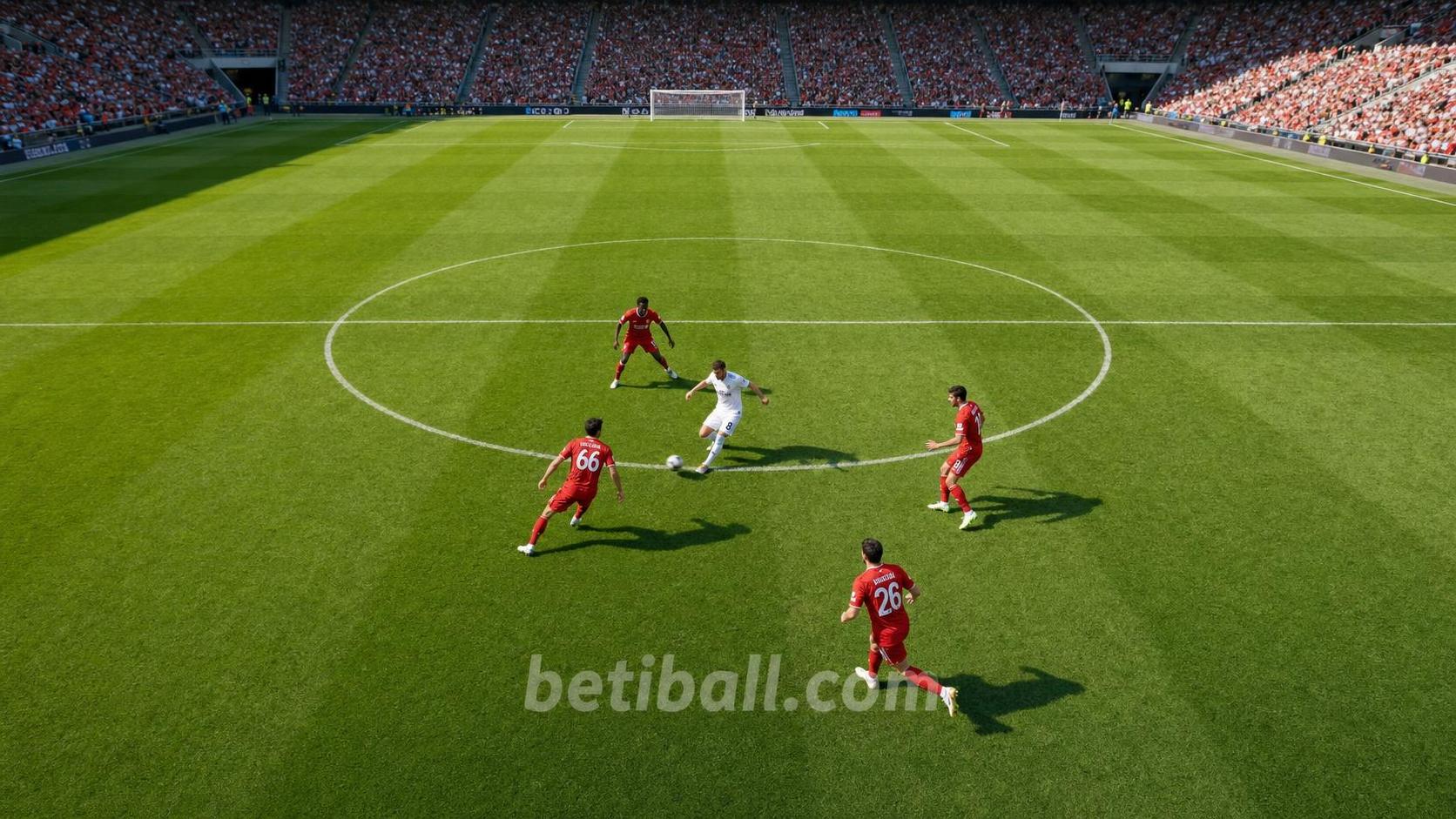
What Exactly Are Pressing Tactics in Football?
Pressing, at its core, is the organised act of a team actively hunting the ball when out of possession rather than sitting in a passive defensive shape. Instead of retreating and compressing space near their own goal, pressing teams push up the pitch and force opponents into errors higher up the field. The logic is elegant: the closer a turnover happens to the opponent's goal, the more dangerous and immediate the counter-attack opportunity becomes.
There are several distinct pressing systems coaches deploy today, and conflating them leads to analytical errors:
- High press football — The team's entire defensive line sits high up the pitch, often inside the opponent's half. The aim is to suffocate build-up play at source, forcing goalkeeper long balls or rushed distribution. Liverpool under Jürgen Klopp (2016–2024) became the textbook case study.
- Gegenpressing — A German tactical concept meaning "counter-pressing." Rather than immediately retreating after losing the ball, the team attacks the space around the turnover point within three to five seconds. It is reactive rather than pre-set, and it is the signature weapon of teams coached by Klopp, Ralf Rangnick, and their disciples.
- Mid-block press — The team presses once opponents enter the middle third but does not commit high lines. More conservative, less vertical risk.
- Low block with press triggers — Primarily defensive, but specific situations (back-pass to goalkeeper, a slow lateral pass) trigger short, intense pressing bursts before the team resets.
The distinction matters enormously for match analysis. A team employing a genuine high press will concede more space in behind but generate significantly more high-turnover opportunities in dangerous areas. A mid-block presser defends differently, gives up different types of chances, and produces different Expected Goals (xG) profiles on both ends of the pitch.
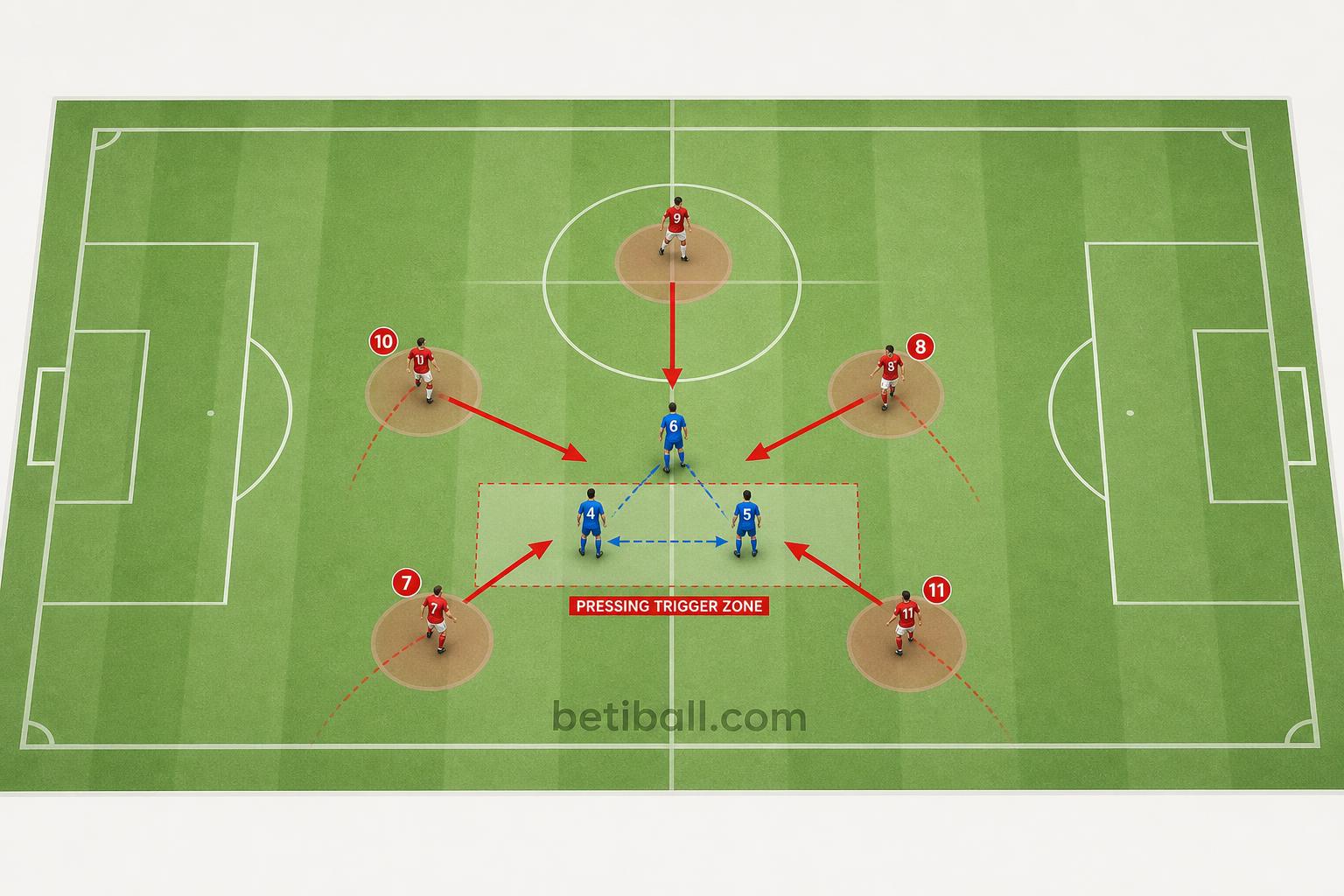
How Do We Measure Pressing Intensity?
Tactical labels assigned by commentators are often imprecise. At Betiball, we rely on quantified pressing metrics sourced from tracking data providers to create objective pressing profiles for every club in our database. The primary metrics we use are:
- PPDA (Passes Allowed Per Defensive Action) — The ratio of opponent passes to the pressing team's defensive actions (tackles, interceptions, fouls) in the opponent's 60% of the pitch. A lower PPDA = more aggressive press. Elite pressers like Manchester City and Arsenal routinely post PPDA values between 6 and 8. A passive low-block team may sit at 15–20.
- High Turnovers (OTIP — Opponent Turnovers in Possession) — Specifically turnovers forced in the opponent's final third. This is the direct output of successful high pressing.
- Pressing Success Rate — What percentage of pressing sequences result in a defensive action or forced long ball within five seconds.
- Counterpressing Recoveries — Ball recoveries within five seconds of losing possession, a direct measure of gegenpressing effectiveness.
| Club | PPDA | High Turnovers / 90 min | Counterpressing Recoveries / 90 min | Goals Scored from High Turnovers |
|---|---|---|---|---|
| Manchester City | 6.4 | 5.8 | 24.1 | 18 |
| Arsenal | 7.1 | 6.2 | 26.3 | 22 |
| Brighton & Hove Albion | 7.8 | 5.4 | 22.7 | 14 |
| Brentford | 10.3 | 3.9 | 18.2 | 9 |
| Burnley | 16.7 | 2.1 | 11.4 | 4 |
Data sourced from aggregated tracking and event data, 2023-24 Premier League season. Figures rounded to one decimal place.
The table illustrates a clear gradient. Arsenal's combination of low PPDA and the highest high-turnovers-per-90 correlates directly with their league-leading goal output from pressing situations — 22 goals in a single season generated directly from forcing errors in the opponent's half. Burnley's passive approach generated barely a third of those opportunities.

What Do Pressing Stats Actually Tell Us About Match Outcomes?
Beyond aesthetics and tactical theory, the fundamental question is whether pressing intensity has a statistically meaningful relationship with match outcomes. Our analysis of over 3,800 matches across the Premier League, Bundesliga, La Liga, Serie A, and Ligue 1 over the last three seasons reveals several robust patterns:
1. Pressing Mismatches Predict Score Surprises
When a team ranked in the top quartile of PPDA faces a team in the bottom quartile, the high-pressing side wins at a rate of 58.3%, significantly outperforming the base win rate you would expect purely from Elo-adjusted pre-match probability. More importantly, in these mismatches, the high-pressing team scores in the first 30 minutes in 47% of matches — nearly double the average rate for all matches — because early disorganisation in opponent build-up is most exploitable before teams adjust.
2. Fatigue and Late-Match Press Collapse
Pressing is physically expensive. Our data shows that teams with a PPDA below 8.0 (aggressive pressers) see their effective pressing zone retract by an average of 12 metres between the 60th and 85th minute compared to the opening 30 minutes. This is the pressing fatigue window, and it is statistically the period of highest goal probability for the opponent of a pressing team. In matches where aggressive pressers are leading by one goal, opponents score equalizers between the 70th and 90th minute at a rate 23% higher than in matches against passive defending teams.
3. Gegenpressing and Open-Game Goal Totals
Matches featuring at least one team with a counterpressing recovery rate above 22 per 90 minutes produce an average of 2.9 goals, compared to 2.3 goals in matches where neither team meets that threshold. The open, transitional nature of gegenpressing football generates more attempts at both ends, inflating total goal counts. Over the 2022-23 and 2023-24 Bundesliga seasons, the two teams with the highest counterpressing recovery rates were involved in matches that went over 2.5 goals in 64% of fixtures.
Pressing Tactics and What They Mean for Match Analysis
Understanding pressing intensity metrics opens several analytical angles that conventional form tables obscure entirely. Here is how we at Betiball incorporate pressing data into our match previews and statistical models:
Identify the Press vs. Counter-Press Matchup
A team that plays a deep defensive block with fast wide wingers is tactically designed to punish high-pressing opponents. When you see a high-PPDA-rated team facing a disciplined low-block counter-attacking side, the space left in behind the pressing team's defensive line becomes the primary attacking vector. These matchups historically see fewer total goals than pressing-vs-pressing encounters, but a higher rate of exactly one goal matches — ideal for certain result markets.
Check Contextual Pressing Drop-Off
Not all pressing is equal week-to-week. Teams in heavy fixture congestion — three matches in seven days — show measurable PPDA deterioration of 15–22% compared to their rested baseline. This is a context signal we flag in our match previews. A pressing team on a congested schedule is, statistically speaking, going to press less effectively than their season average suggests, which recalibrates expected xG differentials.
Monitor Team News for Press Leaders
Pressing systems are disproportionately reliant on specific players — typically the front three or attacking midfield unit — who initiate and sustain press triggers. The absence of a first-choice pressing forward (injury or suspension) demonstrably increases a team's PPDA by 10–18% in our dataset. This is a player-availability signal that is routinely underpriced in pre-match statistical models that rely only on historical team-level averages.
Betiball does not accept bets. All examples are for educational purposes only.
Conclusion: Pressing Metrics Are an Underused Analytical Tool
Football pressing tactics, when broken down into measurable data — PPDA, high turnover rates, counterpressing recoveries — move from abstract tactical theory into genuinely predictive statistical signals. The evidence is clear: pressing mismatches correlate with early goals, gegenpressing matchups inflate total goals, and pressing fatigue creates identifiable late-match vulnerability windows. For anyone serious about reading matches beyond league position and recent form, integrating pressing intensity into pre-match analysis is not optional — it is essential.
At Betiball, we publish pressing metric breakdowns for all major European fixtures as part of our weekly match previews. Our statistical models weight PPDA differentials, counterpressing recovery rates, and contextual congestion adjustments alongside traditional xG and form data to produce more complete match profiles. If you want to go deeper on any specific fixture or league, explore our full statistics hub and match preview library to see how pressing shapes the games you follow most closely.
Read more:

Your feedback helps us deliver better football betting insights.