

 Account
 Language
 Time Zone
 COEF
COEF


1X2 Football Betting Explained: How Match Result Odds Work
Learn how 1x2 football betting works, how home draw away odds are priced, and how to calculate 1x2 probability like a pro. Explore more on Betiball.



If you are new to football wagering or simply want to sharpen your edge, understanding 1x2 football betting explained from first principles is the smartest place to start. The 1x2 market is the most traded bet type in football worldwide, yet many bettors place money on it without truly understanding how bookmakers price it, where the margin hides, or how implied probability should guide every selection. This guide breaks down the mechanics in precise, data-backed terms so you can approach match result betting with real analytical confidence.
Betiball aggregates football statistics and model-driven predictions across hundreds of leagues, making it an ideal companion platform as you apply what you learn below.

What Is 1X2 Betting in Football?
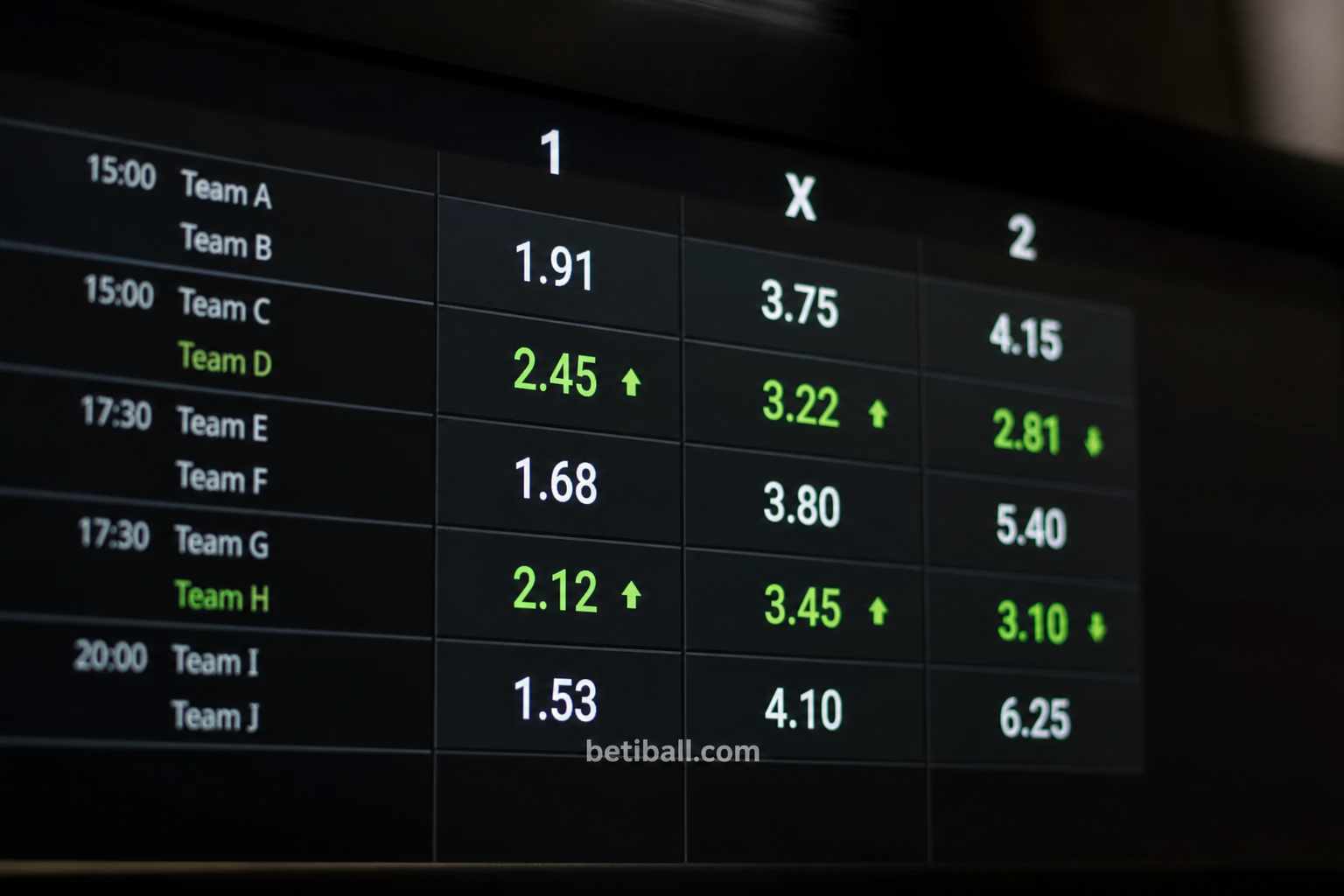
The name derives directly from the three possible outcomes of a regulated football match. In betting shorthand, 1 represents a home win, X represents a draw, and 2 represents an away win. Together, these three options cover every conceivable result at full time, which makes 1x2 a closed market — one of the very few bet types where all outcomes are mutually exclusive and collectively exhaustive.
Because there are only three outcomes, the market is structurally simple. However, simplicity on the surface conceals considerable depth in the pricing. A bookmaker's job is to set home draw away odds that reflect perceived probability while also embedding a profit margin, often called the overround or vig. Your job as a bettor is to identify when those odds misprice the true probability of each outcome.
Match result betting applies to the outcome at the end of 90 minutes plus stoppage time. Extra time and penalty shootouts do not count unless a specific market states otherwise. This distinction matters enormously when betting on cup fixtures.
How 1X2 Odds Work and Where the Margin Is Hidden
Bookmakers express 1x2 odds in decimal, fractional, or American format. For analytical purposes, decimal odds are the most transparent because converting them to implied probability is a one-step calculation.
The formula is straightforward:
Implied Probability = 1 ÷ Decimal Odds
Consider a match priced at the following decimal odds:
- Home Win (1): 2.10
- Draw (X): 3.40
- Away Win (2): 3.60
Converting each to implied probability:
- Home Win: 1 ÷ 2.10 = 47.62%
- Draw: 1 ÷ 3.40 = 29.41%
- Away Win: 1 ÷ 3.60 = 27.78%
Summing those percentages gives 104.81%. In a fair, zero-margin market, the total would equal exactly 100%. The excess — 4.81 percentage points in this case — is the bookmaker's overround. It is distributed across all three outcomes, quietly reducing the value of every bet you place.
To find the true fair odds implied by this book, divide each implied probability by the total overround sum (1.0481):
- Fair Home Win probability: 47.62% ÷ 1.0481 = 45.43%
- Fair Draw probability: 29.41% ÷ 1.0481 = 28.06%
- Fair Away Win probability: 27.78% ÷ 1.0481 = 26.50%
These normalised figures now sum to 100% and represent the bookmaker's actual probabilistic view of the match, stripped of margin. This is the baseline any serious bettor should compare against their own model or data source.
A Numeric Example: Calculating 1X2 Probability Step by Step
Let us work through a concrete Premier League scenario to make 1x2 probability calculation tangible.
Fixture: Arsenal (Home) vs Chelsea (Away)
Market odds (decimal):
- 1 (Arsenal Win): 1.95
- X (Draw): 3.50
- 2 (Chelsea Win): 4.20
Step 1 — Convert to raw implied probabilities:
- Arsenal Win: 1 ÷ 1.95 = 51.28%
- Draw: 1 ÷ 3.50 = 28.57%
- Chelsea Win: 1 ÷ 4.20 = 23.81%
- Total: 103.66%
Step 2 — Identify the overround: 103.66% − 100% = 3.66% bookmaker margin.
Step 3 — Normalise to fair probabilities:
- Arsenal Win: 51.28% ÷ 1.0366 = 49.47%
- Draw: 28.57% ÷ 1.0366 = 27.56%
- Chelsea Win: 23.81% ÷ 1.0366 = 22.97%
Step 4 — Compare with your own model. Suppose your statistical model, built from xG data, head-to-head records, and form indexes, estimates Arsenal's true win probability at 54%. The bookmaker's fair-priced implied probability is only 49.47%. That 4.53-percentage-point gap represents a potential edge. At odds of 1.95, the expected value (EV) calculation is:
EV = (0.54 × 0.95) − (0.46 × 1) = 0.513 − 0.46 = +0.053
A positive EV of +5.3% per unit wagered suggests this selection has mathematical value, assuming your model's probability estimate is accurate. This is the core discipline of value betting on 1x2 markets.

When to Use the 1X2 Market Over Other Bet Types
The 1x2 market is most efficient — meaning bookmakers price it most accurately — in top-tier leagues with deep liquidity: the Premier League, La Liga, Bundesliga, Serie A, and Champions League. In these competitions, thousands of sophisticated bettors and trading algorithms constantly pressure prices toward their true probabilities. Finding edge here requires rigorous modelling.
Conversely, the market can be less efficiently priced in lower leagues, international friendlies, and women's football competitions, where bookmaker resources and sharp money are comparatively thin. That relative inefficiency creates opportunities for bettors who invest in specific niche knowledge.
The 1x2 market is particularly well-suited in these scenarios:
- High-draw-probability fixtures: Tactical, low-scoring derbies where the draw is a genuine strategic outcome for both managers. Many models underrate the draw because it feels like a non-event, yet historically around 25-27% of top-flight matches end level.
- Strong home favourites in form: When a team ranks in the top quartile of expected goals for and against simultaneously, backing the home win often carries better value than handicap markets in the same fixture.
- Away win at inflated odds: In fixtures where public bias heavily backs the home side, the away win odds can drift to levels that overprice the visiting team's actual risk.
Always cross-reference the Betiball market filter for the specific league you are analysing to see model probabilities alongside live odds data before committing to any selection.
Common Mistakes Bettors Make in Match Result Betting
Even experienced football bettors consistently fall into identifiable traps when approaching 1x2 markets. Recognising these patterns is as important as understanding the mathematics.
1. Ignoring the draw systematically. The X outcome is the most frequently underestimated of the three. Because bettors naturally think in binary terms — team A wins or team B wins — the draw gets overlooked. In reality, draws occur in roughly one in four professional matches. Dismissing the draw without analytical justification is not a strategy; it is a bias.
2. Treating odds as probability without adjusting for overround. A price of 2.00 does not mean a 50% probability. It means a raw implied probability of 50% before the margin is removed. The normalised probability is lower. Bettors who skip this adjustment will systematically overestimate how much value they hold.
3. Chasing recency bias in form analysis. A team winning three consecutive matches does not inherently make them a better 1x2 bet if the underlying performance metrics — shots on target ratio, expected goals differential, pressing intensity — have actually declined. Price-to-performance divergence is where real value lives.
4. Underestimating line movement context. When 1x2 odds shift significantly in the hours before kick-off, it rarely happens without cause. Sharp money from professional syndicates is almost always the driver. Tracking the direction and magnitude of line movement is a supplementary signal, not the primary basis for a selection, but ignoring it entirely is negligent.
5. Staking flat amounts regardless of edge size. A 1x2 bet with a modelled edge of 2% warrants a smaller stake than one with a 7% edge. Applying the Kelly Criterion or a fractional variant to your staking plan is essential for long-term bankroll management in match result betting.

Betiball does not accept bets. All examples are for educational purposes only.
Conclusion: Build Your 1X2 Edge on Data, Not Instinct
The 1x2 football betting market rewards bettors who go beyond gut feeling and develop a disciplined, probability-first approach. Understanding exactly how home draw away odds are constructed, where the overround is embedded, and how to calculate the true fair probability of each outcome is the analytical foundation every serious bettor needs. Pair that framework with quality underlying data, maintain rigorous records, and use platforms like Betiball to benchmark your model estimates against real market prices. The edge is there for those willing to do the work.
Read more:

Your feedback helps us deliver better football betting insights.