

 Account
 Language
 Time Zone
 COEF
COEF


10 Football Betting Mistakes to Avoid If You Want to Win
Discover 10 costly football betting mistakes to avoid, from poor bankroll management to chasing losses. Fix your strategy with data. Explore more on Betiball.



Every serious bettor has felt it — the sting of a preventable loss. Whether you are just starting out or have been analysing fixtures for years, Betiball has identified the most damaging football betting mistakes to avoid across thousands of match predictions and user data points. These are not random errors. They are systematic, repeatable patterns that drain bankrolls silently. Read on to find out which ones are costing you money — and exactly how to correct them.

Who This Guide Is For
This article is aimed at analytical football bettors — people who study form tables, track head-to-head records, and want evidence-based reasons for why their strategy may be underperforming. If you place bets based on gut feel alone, this guide will challenge how you think. If you already use data tools, it will sharpen your edge. Either way, understanding common betting mistakes is the single fastest way to improve your long-term results.
The Most Common Betting Mistakes Beginners Make
Before advanced strategy can work, foundational errors must be eliminated. These are the mistakes that account for the majority of losses among casual bettors.
1. Ignoring Value and Chasing Big Odds
Many bettors are attracted to high-odds selections purely because the potential payout is exciting. This is one of the most destructive common betting mistakes. A selection at 10/1 is only a good bet if the true probability of it occurring is greater than 9.1%. Bookmakers consistently overprice long-shots to attract volume. Data shows that in major European leagues, selections priced above 6.00 lose at a rate that far outpaces the implied probability advantage.
Fix it: Calculate implied probability before placing any bet. If the bookmaker's odds imply a 12% chance but your model suggests 8%, it is not value — it is a trap.
2. Betting on Every Match
Over-betting is a volume problem disguised as enthusiasm. Bettors who wager on every match of a weekend fixture list are not increasing their chances of profit — they are increasing their exposure to variance without edge. Professional bettors typically identify 2–5 high-confidence selections per week, not 20.
Fix it: Set a minimum threshold for confidence before placing a bet. If you cannot articulate three data-backed reasons for a selection, skip it.
3. Neglecting Bankroll Management
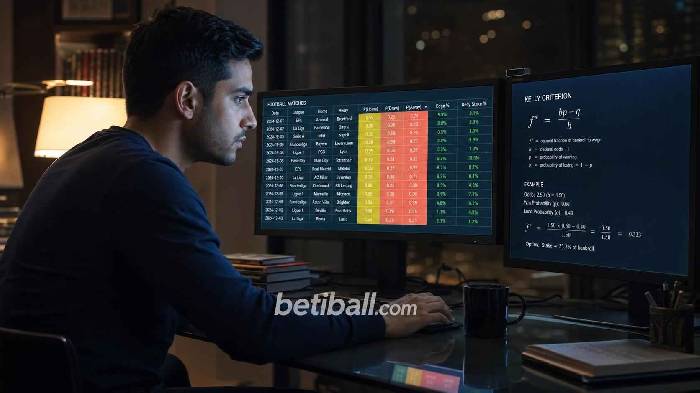
Betting discipline starts with bankroll structure. Staking 20% of your total fund on a single match — regardless of how confident you feel — is a quick path to ruin. The Kelly Criterion, used by professional bettors, suggests that optimal stake size is proportional to your edge, not your confidence or emotion.
Fix it: Limit individual stakes to 1–5% of your total bankroll. Use flat staking if you are still developing your model.
4. Not Keeping Records
You cannot improve what you do not measure. Most bettors who lose money have no idea which bet types, leagues, or markets are dragging their ROI down. A simple spreadsheet tracking stake, odds, market, result, and profit/loss will reveal patterns within weeks.
Fix it: Record every single bet before it starts, not after. Include your reasoning so you can audit decisions, not just outcomes.

Advanced Mistakes That Even Experienced Bettors Make
These errors are subtler, but their financial impact is significant. They appear in bettors who have moved past the basics but have not yet reached a fully systematic approach.
5. Recency Bias in Form Analysis
Overweighting a team's last three results — especially a high-profile win or loss — distorts true form assessment. A team that won 4–0 in their last fixture may have benefited from a weakened opponent, an early red card, or exceptional finishing variance. Expected Goals (xG) data often tells a very different story than the scoreline.
Fix it: Always assess rolling form across at least eight matches. Use xG metrics alongside raw results to identify genuine momentum versus statistical noise.
6. Ignoring Market Movement
Odds movement between publication and kick-off is a signal, not just a number. Sharp money from professional bettors moves lines. If a team opens at 2.10 and drifts to 2.60 by match day, the market is telling you something — perhaps a key player is doubtful, or professional models disagree with the public sentiment.
Fix it: Monitor opening odds versus closing odds. Closing line value (CLV) is one of the most reliable predictors of long-term betting profitability.
7. Emotional Betting After Losses
Chasing losses is perhaps the single biggest reason why bettors lose money in the long run. After a bad run, the emotional impulse is to increase stakes to recover quickly. This amplifies variance and compounds losses. It is a direct failure of betting discipline.
Fix it: Set a hard rule: stake size never increases after a losing run. If you have lost three consecutive bets, take a 24-hour break before placing another.
8. Betting in Markets You Do Not Understand
Asian Handicap, Both Teams to Score, and Correct Score markets each have distinct mathematical structures. Treating them as interchangeable with 1X2 markets is a fundamental error. Each market type has a different bookmaker margin profile and requires different analytical inputs.
Fix it: Master one market type deeply before expanding. Understand the margin structure of each market before applying your model to it.

Strategy Tips to Sharpen Your Edge
9. Failing to Specialise in a League or Market
Trying to bet profitably across the Premier League, La Liga, Bundesliga, Championship, and Serie A simultaneously is a data management problem. Each league has unique tactical trends, referee tendencies, home advantage strength, and injury reporting cultures. Spreading too thin dilutes edge.
Fix it: Choose two leagues and two markets. Go deep, not wide. Build a league-specific database and review it monthly.
10. Treating Predictions as Certainties
Even the most sophisticated statistical model carries uncertainty. Football is a low-scoring, high-variance sport where the better team wins only approximately 45–50% of the time in single match scenarios. Overconfidence leads to oversizing stakes and mismanaging risk.
Fix it: Think in probabilities, not predictions. "This team will win" should always be "I estimate a 68% probability of this team winning, compared to the implied 52% from the odds." That gap is your edge — protect it.
Quick-Reference Checklist: Before Every Bet
| Check | Question to Ask | Done? |
|---|---|---|
| Value Check | Does my probability estimate beat the implied odds? | ☐ |
| Form Analysis | Have I reviewed 8+ matches using xG data, not just scores? | ☐ |
| Market Movement | Have I checked odds movement from open to current? | ☐ |
| Bankroll Rule | Is my stake within my 1–5% bankroll limit? | ☐ |
| Emotion Check | Am I betting from analysis, not to chase a loss? | ☐ |
| Market Knowledge | Do I fully understand the market structure I am betting in? | ☐ |
| Record Keeping | Have I logged this bet with my full reasoning before placing? | ☐ |

Conclusion: Discipline Is the Real Edge
The bettors who achieve consistent long-term results are not necessarily smarter than everyone else — they are more disciplined. They avoid the emotional traps, they specialise, they respect variance, and they treat every bet as a data point in a larger strategy rather than an isolated gamble. The ten mistakes outlined above are avoidable with structured thinking and the right tools. Use the checklist before every bet. Revisit your records monthly. And remember: the goal is not to win every bet — it is to build a process where the mathematics works in your favour over time.
Betiball does not accept bets. All examples are for educational purposes only.
Read more:

Your feedback helps us deliver better football betting insights.